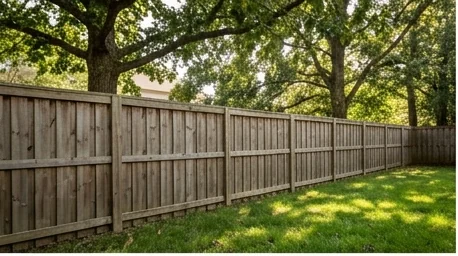
Summer Humidity and Wood Fence Warping
Wood moves here. What cupping, bowing, and twisting actually are, and which choices keep a board flat.
Jackson's climate is humid subtropical. Hot, wet summers, and something around fifty-seven inches of rain in an average year. Wood in that air is never at a fixed moisture content, and a wood fence is a few hundred boards all reacting to it at once.
So boards move. That is not a defect, it is the material. What separates a fence that looks straight for years from one that goes ragged in its first summer is a handful of choices made at install and a couple more made by the homeowner afterward.
Here is what is actually happening and what to do about it.
Get a free estimate
Call or text Greg at (731) 555-1234, or use the form. Photos of your yard help.
Free on-site estimates in Jackson & West Tennessee.
Cup, Bow, and Twist Are Three Different Problems
People say warped and mean any of these, but they have different causes and different fixes.
- Cup is the board curling across its width, so the face becomes a shallow trough or dome. It happens because one face dries faster than the other, and the grain pattern determines which way it curls. It is the most common movement on a fence board.
- Bow is the board bending along its length, face to face, so the middle pulls away from the rail while the ends stay put. Often visible from the end of a run as a wavy face.
- Twist is the board winding, so the two ends are no longer in the same plane. This is the ugly one and the hardest to fix, and it usually traces back to grain that ran off through the board rather than anything done at install.
- Crook is bending edgewise, which shows up as boards that no longer look parallel and gaps that open unevenly.
Cup and bow can often be pulled back with an added fastener or a third rail. Twist mostly cannot, and a badly twisted board is a replacement rather than a repair.
Why Boards Move Most in the First Season
Pressure-treated lumber comes off the rack wet. The treatment is driven into the wood with water, and a lot of that water is still in the board when it is delivered.
So a new treated fence is going to lose moisture and change dimension no matter what. Boards shrink slightly in width, which is why gaps in a picket fence often look wider a few months after install than they did on day one. That is the wood settling to the local air, not sloppy work.
The mitigation is acclimation. Letting the material sit stacked and separated, out of the weather but with air moving through it, gets some of that shrinkage over with before the boards are fastened down. How practical that is depends on the job and the schedule, and it is a reasonable thing to ask a contractor about. What matters most is that it gets handled deliberately rather than pretending wet lumber is dry.
Fasteners Decide Whether a Board Can Move
A board that wants to cup will cup. The question is whether the fastener holds it flat or lets go.
Ring-shank or coated deck screws hold far better than smooth nails, which back out as wood cycles wet and dry. That backing-out process is why old fences develop that row of nail heads standing proud of the boards. Two fasteners per rail rather than one also resists the board rotating, and on wide boards it matters a lot.
The other half is the finish. Galvanized or coated fasteners rated for treated lumber are not optional here, because modern treatment chemistry is hard on plain steel. Use the wrong fastener and you get rust streaks bleeding down a new fence within a year, plus corrosion where you cannot see it. See wood fencing for material detail.
Get a free estimate
Call or text Greg at (731) 555-1234, or use the form. Photos of your yard help.
Free on-site estimates in Jackson & West Tennessee.
Spacing and Style Change How Much Movement Shows
You can design around wood movement to a degree, which is worth knowing before you pick a style.
A tight board-to-board privacy fence gives movement nowhere to go. Boards butted with zero gap will push against each other as they swell, and the run either buckles or the gaps open unevenly later. Leaving a small deliberate gap is what a careful builder does, even on a fence meant to be solid.
Board on board and shadowbox both handle this better, because the overlap means a gap that opens up behind a board does not become a sight line. That is a real advantage in this climate and a reason those styles show up so often around here. See board-on-board and shadowbox fencing and the privacy fence guide.
Horizontal slat fences deserve a specific mention: a horizontal board sags over its span in a way a vertical one does not, so post spacing and board thickness matter more. See horizontal slat fencing.
When to Stain New Treated Wood
The instinct is to stain the fence right away, while it looks good and while you are still motivated. On new pressure-treated lumber, that is usually too soon.
Wet wood will not take a finish properly. Stain applied to a board still full of treatment moisture sits on the surface instead of penetrating, then peels or blotches as the wood dries underneath. The standard homeowner test is to sprinkle water on the wood: if it beads and sits, the board is not ready; if it soaks in, it is.
Cedar behaves differently and can generally be finished sooner, though it also weathers to gray attractively if you would rather leave it. Either way, the useful rule is to check the wood rather than the calendar. Our fence staining and sealing page covers the products and timing, and the fence lifespan guide covers what maintenance buys you here.
What You Can Do After the Fence Is Up
A few habits make a real difference in this climate:
- Keep the bottom of the fence clear. Mulch, clippings, and soil banked against boards hold moisture right where rot starts.
- Trim growth off the fence. Vines and shrubs pressed against boards keep them damp and shaded, and they never dry out properly.
- Do not aim sprinklers at it. Repeated wetting on one stretch is the fastest way to make one run look older than the rest.
- Refasten what backs out in the first year or two, while a cupped board can still be pulled flat.
- Wait out seasonal binding on gates rather than rebuilding. A wood gate swells in July and frees up in January, and that is usually a clearance adjustment.
Common Questions About Wood Fence Warping
Is a warped fence board a defect or normal?
+Some movement is normal and expected, particularly in the first season as treated lumber gives up its moisture. A few boards cupping across a long fence is the material. A whole run going wavy, or boards twisting badly, points at material selection, fastening, or spacing.
Can a warped fence board be fixed?
+Cupped and bowed boards can often be pulled back with added fasteners, and sometimes with a third rail to shorten the unsupported span. A twisted board generally cannot be straightened and is better replaced. See fence repair.
Why did gaps appear in my new fence?
+Treated boards are wet when they arrive and shrink slightly in width as they dry to the local air. Gaps that were tight on install day often read wider a few months later. It is the wood equalizing, not the fence coming apart.
How soon can I stain a new treated wood fence?
+Test the wood instead of guessing. Sprinkle water on a board: if it beads up, the wood is still too wet to take a finish and stain will peel or blotch. When it soaks in readily, the board is ready. Cedar is generally ready sooner than treated pine.
The Honest Bottom Line
In this climate wood moves, and a fence built as though it will not is the one that looks rough by its second summer. Deliberate spacing, screws rated for treated lumber, two per rail, a style that tolerates movement, and patience before staining. That is most of it.
If you want the look of wood with none of the movement, that conversation is worth having too. See vinyl fencing or the materials guide for the comparison.
Get a free estimate
Call or text Greg at (731) 555-1234, or use the form. Photos of your yard help.
Free on-site estimates in Jackson & West Tennessee.