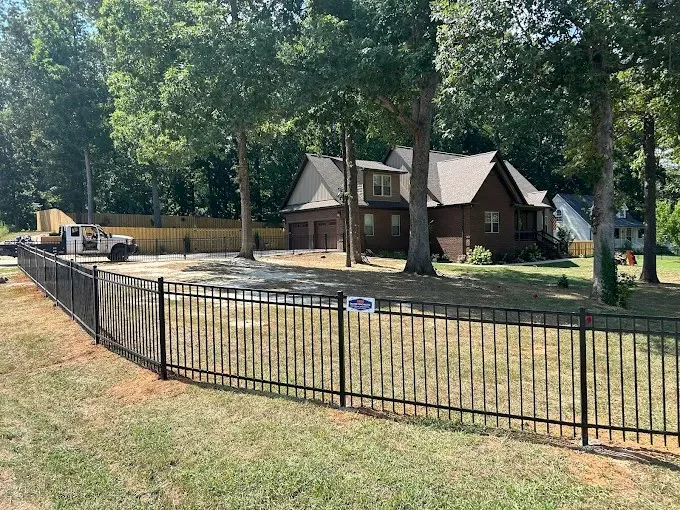
Security Fencing for Jackson, TN Properties
A security fence is not just a taller fence. It is height plus a face nobody can climb plus a gate that is actually the strong point instead of the weak one.
Height Is Only a Third of It
When somebody calls about security fence, they almost always lead with height. Height matters, and it is the part people overestimate. A tall fence with something to grab on the way up is a tall fence somebody climbs. A shorter fence with a face that gives no hold and a gate that cannot be defeated does more real work.
There are three things to get right and they are not interchangeable. How high the top is. Whether the face offers any foothold or handhold. And whether the gate and its hardware are the strongest part of the line or the easiest way in. Get the third one wrong and the other two do not matter, because nobody climbs a fence when they can walk through the gate. We build security fence for commercial yards, equipment lots, utility sites, and residential properties across Jackson and the surrounding counties, inside our broader commercial fencing work.
Get a free estimate
Call or text Greg at (731) 555-1234, or use the form. Photos of your yard help.
Free on-site estimates in Jackson & West Tennessee.
Climbability, which is the part that gets designed wrong
A fence is climbable if it offers a place to put a foot and a place to put a hand. That is the whole test, and it has nothing to do with height.
What makes a fence easy to climb:
- Horizontal members on the accessible face. Rails on the outside are a ladder, and this is the most common design error on a fence somebody paid extra for.
- Chain link mesh. Every opening is a toe hold. A good fence for many reasons, and the easiest common fence to climb.
- A flat, graspable top rail. A rail you can get both hands around is the handhold that makes the pull-up possible.
- Anything stacked against it. Pallets, tires, equipment, a dumpster parked beside it, a limb over it. People bring a fence down to a climbable height by putting something next to it, inside as often as outside.
What makes a fence hard to climb:
- No horizontals on the accessible face. Rails on the secure side, or at the very top and bottom where they help least.
- Pickets extended above the top rail. Spear-top ornamental metal puts points where the hands need to go and removes the graspable edge. Effective without being a hazard product. See ornamental iron and aluminum fencing.
- Tight mesh. Small-aperture welded panels give no fingerhold at all, the quiet best answer where the budget allows.
- Smooth solid face. Nothing to grip, which is also what works on a dog that climbs.
- A clear zone on both sides. Nothing stored within reach. Costs nothing, and the most commonly ignored item here.
On razor wire and barbed wire: not on residential property, and we do not recommend either for a home under any framing. They are hazards to people who have every right to be near your fence, and they invite liability nobody wants. Where an industrial site has a genuine requirement for a topping product, that is a conversation with the site's own security standard and whoever enforces it, not something we put on a quote because it sounds tough. For nearly every property, extended pickets or tight mesh does the job.
Height, and the local rules that constrain it
Taller is better for delay, and there is a point where more height buys less than fixing the face or the gate. A fence at chest height is a boundary marker and stops nothing. A fence you cannot see over or easily reach the top of is a real obstacle. Past that, each added foot adds cost, adds wind load, and may trip a permit threshold.
The rules that apply here:
- Inside the City of Jackson, a fence permit is required for fence installation, and the application asks for a certified boundary survey or a signed neighbor agreement. In any required front yard, no fence or wall may materially impede vision above two and a half feet. That is a hard constraint on a tall fence across a street frontage.
- On a corner lot in the city, nothing may impede vision between two and a half and ten feet above the centerline grade of the intersecting streets, inside the area bounded by the street lines. A driveway entrance at a corner is where this bites.
- In unincorporated Madison County, no building permit is required for a standard residential fence seven feet or under. Taller triggers a permit and structural review, which is very relevant here because the height you want is often above that line. The county building department is (731) 423-6014, and the county has adopted the 2018 edition international codes.
- On a county corner lot, the sight triangle is larger: no obstruction between two and a half and ten feet, inside the area formed by the centerlines of the intersecting streets and a line joining points one hundred feet from the intersection.
- Commercial sites can carry site-plan conditions more specific than the zoning baseline. If a plan, approval condition, or inspector's letter names a height or material, that document governs.
We confirm current requirements with the office that has jurisdiction over your address before quoting a tall fence. The residential picture is in the permits and rules guide.
Gates and access control
The gate is the security fence. Everything else on the property is just the wall that makes people use the gate.
What a security gate needs that a residential gate does not:
- Posts sized for the leaf and then some. A heavy gate on an undersized post walks it out of plumb, a sagging gate does not latch, and a gate that does not latch gets left open. That chain is how most yards actually get entered.
- Welded braced frames. A leaf that racks is a leaf you can lift and lever.
- Hardware that resists the obvious attacks. Hinges that cannot be lifted off, and a latch and lock housing not exposed to a bolt cutter on the outside face.
- No gap you can reach through. A gap at the hinge side or under the leaf is where a hand gets to the inside latch.
- A gate top that matches the fence top. Extended pickets on the fence and a flat graspable rail on the gate hands somebody the route.
- Enough gates, in the right places. One gate is a bottleneck that gets propped open for convenience. A separate personnel gate and vehicle gate means the big one stays shut.
Access control is where a security fence stops being carpentry. A slide or swing gate on an operator with a keypad, card reader, loop detector, or remote closes itself every time, which removes the human factor that defeats most gates, and depending on the system it records who came in. On a lot of commercial jobs the access control is the real project and the fence is what goes around it. See automatic gate installation, automatic gate systems, and gate installation and repair.
One practical note on powered gates: know what happens in a power failure and decide whether the gate should fail open or fail secure. That is a business decision, and it should be made deliberately rather than discovered.
Sightlines and lighting, and the tradeoff nobody mentions
There is a real tension in security fence design and most quotes ignore it.
A solid fence screens what is inside, so nobody sees your equipment and nobody targets it. That is genuine value. The same fence also means nobody can see a person standing inside it. Somebody over the fence is invisible from the street, from a neighboring business, and from a patrol car going past. You traded deterrence-by-concealment for the loss of anybody noticing.
An open fence, ornamental picket or mesh, goes the other way. Your inventory is visible, and so is anybody inside the line, from every direction. For most commercial yards with any traffic nearby that visibility is worth more than the screening, and it is why so much serious perimeter fence is open rather than solid.
Lighting is the other half, and it only works with sightlines. A well-lit yard behind a solid screen is lit for nobody. Lighting also has to point in useful directions: a light aimed outward at the fence line blinds the people looking in and leaves the interior dark.
We are not an electrical contractor and we do not install lighting. What we do is lay the fence out so the lighting and cameras somebody else installs have something to work with: keeping the line clear, not creating blind corners at the gate, and not putting a solid panel where the camera needs to see. Say up front if cameras are part of the plan.
A middle path worth knowing: solid or slatted screening on the one face that needs it or faces a road, open fence everywhere else. Slatted chain link is the usual tool, and chain link fencing covers fabric, gauge, and slat options.
West Tennessee conditions on a security perimeter
A security fence is usually a long fence, and long fences here fail at the same two places: the gate posts and the corners.
Our uplands are Gulf Coastal Plain covered in wind-blown silt that holds water, drains poorly once compacted, and moves wet to dry. On a long run the whole line shifts a little and it shows first where the load is highest. On a back yard fence that is cosmetic. On a security perimeter it means a gate that stops meeting its latch, then gets left open, and the fence has stopped working. So gate posts and corners go deeper and heavier than the line, and line spacing goes tighter than residential. See setting fence posts in West Tennessee soil.
Wind is the argument against a solid perimeter. Jackson's record includes two F4 tornadoes and an EF4 across the Union University campus. A tall solid fence around a yard is a large plate with nothing upwind of it, and routine spring wind puts serious load into those posts. Open picket or mesh barely notices. Where screening is required, slatted chain link blocks the view and still lets air through. Recovery work is on storm damage.
Then ordinary humidity, which finds coatings. Galvanized and properly coated steel lasts a long time out here, and it goes at cut ends, scrapes, and fasteners. On a fence that has to keep working, coating class and galvanized hardware are worth the difference. Comparison in the fence lifespan guide.
What moves the price
No figures. What drives a security fence number:
- Perimeter footage. The baseline, and on a yard it is usually a big number.
- Height. Longer posts, deeper footings, more material per foot, more wind load, and possibly a permit threshold.
- Material and anti-climb specification. Chain link, ornamental picket with extended tops, and tight welded mesh panel are three different price levels for three different climb resistances.
- Gauge, coating, and post spacing. The specification inside any given material, and the place where cheap bids get cheap.
- Gates, and how many. The largest single line on most of these jobs, especially a wide vehicle gate.
- Access control. Operators, keypads, readers, loops, and the power and conduit to run them. Often the biggest number on the project.
- Corners and direction changes. Each one is a braced or heavier assembly.
- Grade of the land and access. Long runs across uneven ground take more posts and more time.
- Clearing the line and removing old fence. A fence line grown up in brush or an old fence to pull. Removal is on fence removal and haul-away, and we do not take down trees.
Relative to the rest of what we build: chain link is the least expensive way to enclose a large perimeter, ornamental metal with anti-climb tops sits well above it, and welded mesh security panel is higher still. Access control is priced separately from the fence, because it is a separate system. The Jackson fence cost guide covers how estimates get built.
Get a free estimate
Call or text Greg at (731) 555-1234, or use the form. Photos of your yard help.
Free on-site estimates in Jackson & West Tennessee.
Common questions
How tall does a security fence need to be?
+Tall enough that reaching the top is genuinely difficult, and then the money goes into the face and the gate rather than more height. Height alone does not stop a climb if there are horizontal rails to step on. Local rules constrain it too: Jackson restricts anything impeding vision above two and a half feet in a required front yard, and in unincorporated Madison County a fence over seven feet triggers a permit and structural review.
What makes a fence hard to climb?
+No horizontal members on the accessible face, no graspable top rail, and no toe holds. Ornamental metal with pickets extended above the top rail removes the handhold. Tight welded mesh gives no fingerhold at all. And keep a clear zone on both sides: a pallet, a dumpster, or a stack of tires next to the fence turns any height into a step.
Do you install razor wire or barbed wire on top?
+Not on residential property, and we do not recommend it for a home in any form. It is a hazard to people who have every right to be near your fence and it carries liability you do not want. For almost every property, extended pickets or tight mesh delivers the climb resistance without the hazard. On an industrial site with its own written security standard, that is a conversation with whoever sets and enforces that standard.
Chain link or solid fence for a commercial yard?
+Depends whether you want your yard hidden or watched. A solid fence hides what you store, and it also hides anybody who got inside from the street and from any patrol. An open fence shows your inventory and shows every person inside the line. For most yards with traffic nearby, visibility is worth more. A common middle path is screening the one face that needs it, usually with slatted chain link, and running open fence elsewhere.
Is the gate really the weak point?
+Nearly always, and usually not because somebody defeated it. A gate on undersized posts sags, a sagging gate stops latching, and a gate that will not latch gets left open. Then nobody has to climb anything. Oversized gate posts set deeper, welded braced leaves, hardware that cannot be lifted or cut from outside, and an operator that closes the gate on its own are where the security money goes first.
How we work and where
We walk the whole perimeter with whoever owns the decision and ask what you are protecting and from what, because a yard full of copper and a yard full of mowers are not the same problem. We look at where somebody would actually come in, what is stored next to the line, where the gates have to be, and whether cameras or lighting are in the plan. Then you get a written quote and a scope you can circulate, with the fence and any access control priced separately.
Tennessee law requires notifying 811 at least three full business days before any excavation, hand tools included, and on a commercial lot with private utilities under the pavement that matters. Posts cure before any leaf hangs on them, and gates get worked until they latch clean without a lift.
We build security fence in Jackson, across Madison County, and out through the surrounding counties. Screening enclosures are on dumpster enclosure fencing. Call or text Greg at (731) 555-1234.