Farm and Pasture Fencing in Madison County, TN
Woven wire, board-top, and cross-fencing for Madison County pasture, with corners braced and gates sized for the equipment that actually uses them.
Pasture Fence on Madison County Ground
Past the Jackson city limits, Madison County is real farm and timber ground, and the fence problem changes completely. The runs are long, the corners carry all the load, and the fence has to stand up to animals that lean on it rather than dogs that look at it. The paperwork changes too. Outside the city the county's zoning resolution governs, and a standard residential fence seven feet or under needs no building permit at all.
What follows is this county specifically: the silt we set posts in, the bottomland that takes water, cross-fencing so you can rotate a place, and gates sized for a tractor rather than a pickup. For the material comparison across split rail, post and board, wire-backed, and pipe, see split rail and farm fencing, and the farm and horse fencing guide covers what each animal needs.
Get a free estimate
Call or text Greg at (731) 555-1234, or use the form. Photos of your yard help.
Free on-site estimates in Jackson & West Tennessee.
How we build a farm fence out here
Five steps. On farm work the corners and the gates decide whether the fence lasts, so they come first.
Walk the whole line, not a sample of it
On acreage that takes a while, and it is the part that matters. Corners, low spots, where water crosses, where the fence runs into timber, and where you actually move equipment and animals. A line drawn on a map and a line walked on the ground are different lines.
Confirm the boundary and the rules for your address
In unincorporated Madison County there is no building permit for a residential fence seven feet or under, and taller triggers a permit and structural review. The county's corner rule applies at intersections, with no obstruction to vision between two and a half and ten feet above the average street grade within 100 feet of the crossing. A fence in a designated flood hazard area has a separate development permit. If the address is inside the city, it is a city fence permit instead. See the permits and rules guide.
Written quote with post spacing and bracing spelled out
Fence type, wire or board spec, post spacing, corner and brace count, gate widths, clearing, and old fence removal. On farm work the brace count moves the price as much as footage does, so it is itemized rather than buried.
811, acreage included
Tennessee law requires notifying 811 at least three full business days before any digging, hand tools included, and that applies out here the same as in town. Farms have plenty the utility will not mark, like water lines to a stock tank, a private gas line, or old field tile, so tell us what is out there.
Corners and braces first, then line posts, then wire
Everything on a wire fence depends on the corners holding tension, so those go in first and properly braced rather than just set bigger. Then line posts, wire pulled to real tension, and gates hung and adjusted.
Woven wire, board top, and cross-fencing
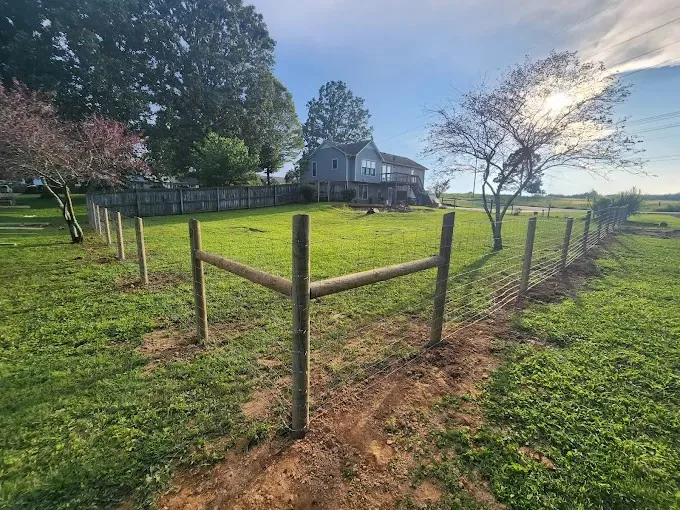
The animal decides the fence. Cattle push and lean, so the load lands on the posts. Horses are the delicate case, since a horse can put a leg through wide-spaced fence and do serious damage. Goats and sheep leave through any gap, so mesh size beats height. The combination that covers most Madison County pasture is woven wire with a board or rail along the top. The wire does the containment, with openings small enough that a hoof or a head cannot go through, and the top board gives the animal a visible line to respect instead of a wire it can walk into. It also stiffens the run and takes gate hardware better than wire alone. Along road frontage that same fence reads as a board fence from the pavement, which is usually what people want out front.
Cross-fencing is the part people put off and then wish they had done first. Splitting a place into paddocks lets you rotate grazing, keep a new or sick animal separate, and stop the whole herd standing in the wettest ground in the wettest month. On this soil that last point is not cosmetic. Cross-fence goes up lighter than the perimeter, but every new corner is still a braced corner.
Field fence and barbed strands remain the workhorse on large cattle acreage, steel pipe is what goes in where animals crowd around a corral or working pen, and vinyl ranch rail is the option where somebody wants the painted board look without repainting it. Which belongs on your place depends on the animal and the run, and we will say when a cheaper fence is the right answer. Material detail is on split rail and farm fencing.
Madison County soil, bottomland, and long runs
Madison County sits in the Gulf Coastal Plain over the Mississippi Embayment, uplands mantled in wind-blown loess. Silt, no rock, which is the biggest difference between fencing here and fencing in Middle Tennessee where the limestone fights back. Out here the hole goes fast, genuinely good news when a line is measured in thousands of feet. The hold is the problem instead of the digging, because loess drains poorly once compacted, holds water, loses strength saturated, and moves through wet and dry cycles.
On a wire fence that movement shows as loose tension and posts walking out of line, worst exactly where the load is: corners, ends, and gate posts. So the fix is bracing rather than bulk. A braced corner transfers the pull into the ground instead of into one post, and in soil that gives, that difference is the fence. Depth and concrete crowned so water sheds off matter on gate posts especially, because a gate post that leans is a gate that drags. More in fence posts in West Tennessee soil.
Bottomland is the other Madison County reality. The South Fork of the Forked Deer River runs through the Jackson area, and plenty of pasture here sits in ground that takes water when the creeks come up. A fence built to hold across a drainage becomes a debris dam, and a dam takes out far more than the section it started in. So a crossing gets built to give and be reset, decided before the wire is strung rather than discovered afterward. If the line crosses a designated flood hazard area there is a separate development permit to confirm. See fencing floodplain lots.
Weather does less to a farm fence than people expect. Madison County is humid subtropical, zone 7b, so posts rated for ground contact are not optional and galvanized wire earns its keep, with cut ends, staple holes, and scraped spots the places rust starts. Wind is mostly a non-issue on an open fence, even in a county with Jackson's tornado record, because there is nothing for the air to push. What takes farm fence out here is falling timber along a tree line, and that is a repair. See storm damage and fence lifespan.
Get a free estimate
Call or text Greg at (731) 555-1234, or use the form. Photos of your yard help.
Free on-site estimates in Jackson & West Tennessee.
Common questions about farm fence in Madison County
Do I need a permit for a farm fence in Madison County?
+In unincorporated Madison County a residential fence seven feet or under does not require a building permit under the county's adopted code, and the county has adopted the 2018 edition of the international codes. Taller brings a permit and structural review. The corner sight rule applies either way, and a designated flood hazard area needs a separate development permit. The county building department is at (731) 423-6014. Inside the Jackson city limits a city fence permit is required instead.
How wide should the equipment gates be?
+Wide enough for the widest thing that has to go through, then a little more. Measure the tractor with the implement mounted, or the trailer, not the pickup. A gate sized to the truck gets scraped, then bent, then replaced. Put them where you actually turn. Hardware is on gate installation and repair, powered entrances on automatic gate installation.
What is the right fence for horses out here?
+Woven wire with openings small enough that a hoof cannot pass through, usually with a top board or rail so the horse sees the fence. Wide-spaced board fence and barbed wire both carry real injury risk with horses. The farm and horse fencing guide works through the options.
Who pays for a fence on a shared property line?
+Tennessee has a partition-fence statute covering shared boundary fences between rural neighbors, and it can require sharing the cost in certain circumstances. Tennessee courts also recognize boundary by acquiescence, where a long-standing mutually respected fence line can become the legal boundary. The specifics deserve an attorney rather than a website. Background in fence line and property disputes.
Why does bracing matter more than post size in this soil?
+Because our loess silt gives. A single big post in silt still pulls over when a wire fence puts steady tension on it. A braced corner spreads that pull across multiple posts and a diagonal, so nothing fights it alone. That is why we brace corners and gate posts instead of just setting them bigger, and it is the detail that separates a fence still tight later from one that sags.
Where this fits with the rest of the work
Farm work in this county usually comes with a house fence, a yard fence, or an entrance gate attached to it. The whole picture across the county is on fence installation in Madison County, in-town addresses on Jackson, new line generally on fence installation, and repairs on fence repair.
Call or text Greg at (731) 555-1234 and we will come walk the property.