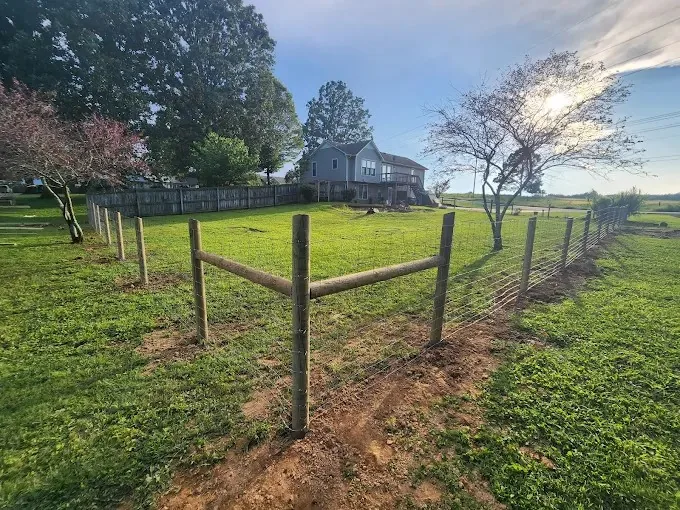
What Madison County's Soils Mean for Fence Posts
A handful of named soils make up most of the county, and they do not all drain the same. Here is how that shows up at the bottom of a post hole.
What soil is under a Madison County fence? Mostly silt loams. Lexington, Feliciana and Smithdale are well drained uplands. Falaya on flood plains and Grenada over its dense layer can hold water in a wet spring. Your own post hole tells you more than any map, so watch what the crew finds.
Most fence advice online was written for somebody else's dirt. West Tennessee's soil is its own thing.
Most of the named soils here are silt loams, which means mostly silt. Smithdale is the exception, with a fine sandy loam surface. In general, silt digs easier than rock, so people figure a fence post is no big deal here. Then the wet months come and silt turns out to have opinions about water.
This page names the soils that cover most of the county, says what each one does with rain, and tells you what to watch for when the hole is open. The broader story of loess and why it behaves the way it does is in our guide to setting posts in West Tennessee soil. This one gets more specific.
One note up front. Soil maps describe large areas. Your back yard can sit on the edge of two soils, or on fill someone hauled in when the house went up. Treat everything below as the background, and treat the hole as the answer.
Get a free estimate
Call or text Greg at (731) 240-8701, or use the form. Photos of your yard help.
Free on-site estimates in Jackson & West Tennessee.
Lexington, Feliciana and Smithdale: The Well-Drained Uplands
If you live on higher ground in Madison County, this is probably what you are standing on. Lexington is the largest share of the county, with Feliciana and Smithdale close behind.
The federal soil survey describes all three as very deep and well drained, with moderate permeability. That is the good news category. Well drained means water moves through instead of sitting, so these are the soils least likely to hold water in a post hole.
Each has its own personality, though.
- Lexington formed in a blanket of wind-blown silt about two to three feet thick, sitting on loamy and sandy material underneath. So a hole can start in silt and change character lower down.
- Feliciana is silt that runs deeper, more than four feet of it. It shows up on everything from level ground to steep slopes, which means slope matters here as much as the soil does.
- Smithdale has a fine sandy loam surface and sits on ridge tops and hillsides, mostly on gentle to steep ground, so slope matters here too.
Well drained does not mean bulletproof. In general, soil softens when it is saturated, and slope sheds water toward the bottom of the lot. A fence on a hillside has its own set of problems, and its low end is where the trouble lands. If your lot tilts, read fence drainage and erosion as well.
Falaya: Creek-Bottom Ground
Falaya is a soil that formed in silt carried in by water, on flood plains. The soil survey calls it somewhat poorly drained, subject to flooding, and says the water table can sit within about twenty inches of the surface when rain is heavy.
That is wet ground. A post set here may be standing in groundwater for part of the year, and a hole can start seeping while you are still digging it. If your lot is low ground near the South Fork of the Forked Deer River, or anywhere in a flood plain, you could be on this kind of soil without knowing it.
Wood that stays wet is more likely to decay, which we cover in our termites and rot guide. So the post material and the base of the hole matter more on a wet run than anywhere else on the lot. That is general practice, not something the soil survey tells you. The floodplain lots guide covers the flooding side of this, including the question of whether the lot sits in a mapped flood area at all.
Grenada: The Hard Layer Under the Silt
Grenada is a silt loam that is only moderately well drained, and the reason is below the surface. Under the silt is a dense layer called a fragipan. According to the soil survey, it starts roughly a foot and a half to three feet down, and can be as shallow as a foot in eroded spots. The survey says it perches water during wet seasons in late winter and early spring.
Think of a bathtub buried under the lawn. Rain soaks the top layer, can not get through the dense layer, and the soil above it stays saturated. A post hole dug through it in March can fill with water that has nowhere to go.
A post whose bottom sits in that perched water in spring and dries out later goes through a wet-and-dry swing that is hard on wood. Grenada is a smaller share of the county than Lexington, but if it is your yard, it is the one to know about.
Loring silt loam is in the county too, but only in small amounts.
How to Find Out What Your Yard Has
You do not need a soil report to build a fence. You need to pay attention to a few things, in about this order.
Look at the lot
Where does water stand after a hard rain? Where does the lawn stay soft? Low spots and slope bottoms are usually where wet-ground problems show up first, whatever a map says.
Walk it after a wet week
Soil behavior shows itself when it is saturated. A walk-through in dry August misses what happens in March. If you can schedule the estimate after rain, do.
Watch the first hole
If water seeps into it, or it changes texture partway down, or something hard stops the auger, your crew should say so and tell you what they plan to do about it. That conversation is the real soil report.
Ask about the wettest run
A contractor who builds the whole perimeter the same way on a lot with one soggy corner is guessing. Ask what changes at the wet spot.
Do not skip the call before the digging starts. Tennessee 811 says fence installation always requires a call, and hand digging counts as excavation. The locate window needs to fit your schedule, and our best time to install guide includes it in the planning timeline.
What Changes When the Ground Changes
Nobody can honestly hand you a post depth over the phone, and this page will not either. What a good crew changes from one soil to another is the approach. The list below is general trade practice, not figures from the soil survey.
- Drainage at the bottom of the hole. On wet or perched-water ground, coarse gravel under the post gives water somewhere to go. On well-drained ground it matters less, but it rarely hurts.
- How long a hole stays open. Holes in loose or wet soil can slump or fill. A hole dug and left overnight may be a different hole in the morning, especially if it rains.
- Post material on the wet run. In general, ground-contact treated wood is the minimum. On a run that stays wet, ask about steel posts or a different system. See wood fencing for what the options look like.
- Depth against height. A taller fence takes more post in the ground. Our post depth and concrete page goes into why.
- Which way the water runs. Posts at the foot of a slope take everything the hill sheds. They get treated differently than posts at the top.
One more thing that ties all of this together. The county's adopted design table rates termite risk as moderate to heavy. UT Extension says termite workers need soil contact for moisture. As general practice, wood that stays wet is also the wood that decays, so wood posts in wet ground are the hard case. That is covered in termites and rot in West Tennessee wood fences.
Get a free estimate
Call or text Greg at (731) 240-8701, or use the form. Photos of your yard help.
Free on-site estimates in Jackson & West Tennessee.
What We Can Not Tell You From a Map
Plenty of websites will tell you your street has this or that soil. We are not going to name soils for specific streets or neighborhoods, because we have not verified any, and a map boundary can miss your lot. It also does not matter that much. A fence crew learns what your yard has the same way a farmer does. By putting something in the ground and watching what happens.
If you want to see the official maps and descriptions, the USDA Natural Resources Conservation Service publishes them, including its Web Soil Survey. For fence work, the practical questions are always the same. Does water stand here. Does the hole cave. What is under the silt.
Common Questions About Soil and Fence Posts
Is Madison County soil clay?
+Mostly not at the surface. Most of the big names here are silt loams, meaning silt with some sand and clay mixed in, and Smithdale has a fine sandy loam surface. The soil survey descriptions show some of them, Lexington for one, have a clay loam layer below the topsoil, so we will not say there is no clay anywhere, but silt is what you meet first. Soaked silt softens, which is why wet spring ground matters.
Which soil is the best for fence posts?
+Well-drained ground like Lexington, Feliciana and Smithdale is easiest on a post, because water leaves instead of sitting. None of them is a free pass. Slope, roots and downspouts can make a bad spot on any soil.
Why does my post hole fill with water in spring?
+Most often a high water table in bottomland, or a perched layer like the dense fragipan under Grenada silt loam, which holds water during wet seasons. Either way, a crew should tell you and change the plan for that hole instead of pouring concrete into standing water.
Can I look up my soil type?
+The USDA publishes a soil survey for Madison County, and its Web Soil Survey lets you look up an address. Remember that a map covers large areas and your lot may be on a boundary or on fill. We still treat the open hole as the real answer.
Does the soil change what kind of fence I should get?
+It changes how the posts get set more than which fence you pick. On a wet run you may want different post material. See the best materials for West Tennessee guide for how material and ground fit together.
Where to Go From Here
If you are planning a fence in Jackson, the ground is one of the few things you can learn before you spend anything. Look at where your water goes and ask your contractor what they do about it. Our fence installation in Jackson page covers the install process. Outside the city, the Madison County fence page covers the rules and the ground.
Get a free estimate
Call or text Greg at (731) 240-8701, or use the form. Photos of your yard help.
Free on-site estimates in Jackson & West Tennessee.
More plain-English answers on cost, permits, materials, and repairs are in all of our fence guides.