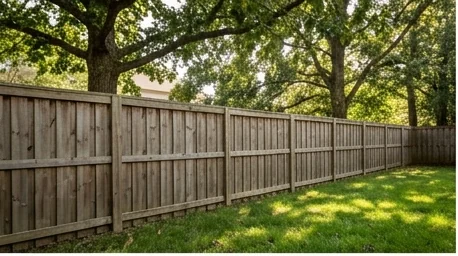
Board-on-Board and Shadowbox Fence Installation
Two wood designs that stagger the pickets instead of butting them edge to edge, so shrinkage never opens a gap and wind has somewhere to go.
Two Ways to Stagger the Pickets, and Why It Matters
Most solid wood fence around here is stockade: pickets nailed edge to edge on one face of the rails. Board-on-board and shadowbox both stop doing that and stagger the boards instead. Board-on-board laps each picket onto the one before it, all on the same side of the rail. Shadowbox alternates them, one on your face, the next on the neighbor's, down the run.
The reason to care is what happens to every stockade fence. Lumber leaves the yard wet and dries on your posts, and as it dries it gives up width. Edge-to-edge pickets pull apart, and you end up looking at daylight between every board on a fence you bought for privacy. Overlapping or alternating builds that shrinkage into the design, so there is nothing to open up. That is why we raise these two on almost every privacy fence walkthrough.
Get a free estimate
Call or text Greg at (731) 555-1234, or use the form. Photos of your yard help.
Free on-site estimates in Jackson & West Tennessee.
How the two designs actually differ
People use the names interchangeably. They are not the same fence.
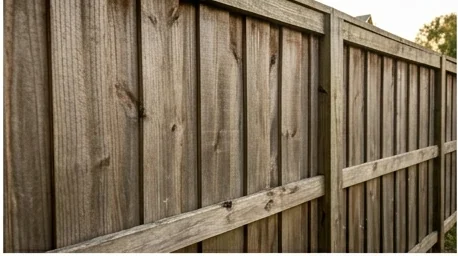
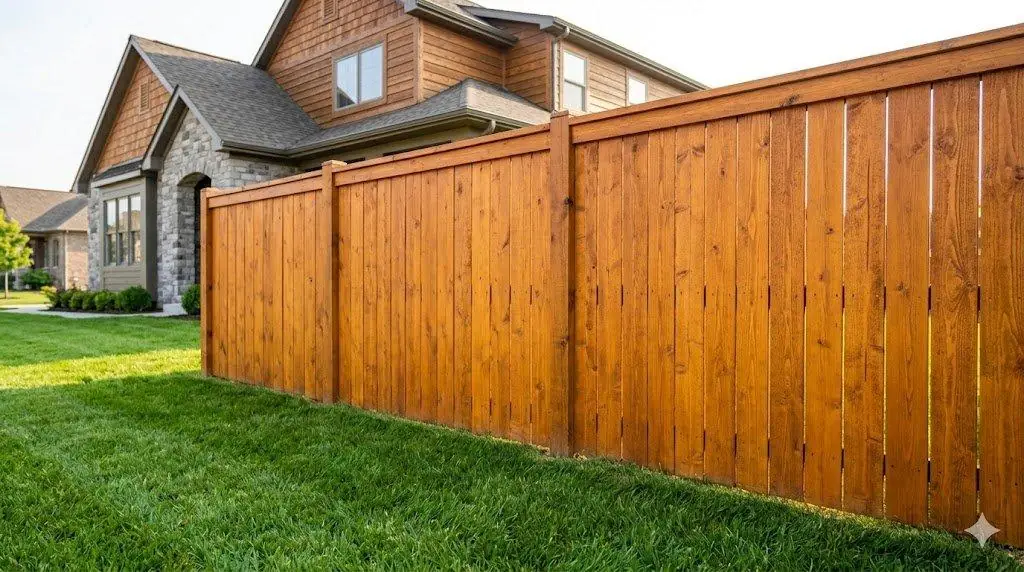
Board-on-board. Every picket laps over the edge of its neighbor, like shingles turned sideways, all on one side of the rails. You get a solid screen with no line of sight through it at any angle, and the overlap throws a shadow line instead of looking flat. Because every board is partly hidden under the next, it eats noticeably more lumber than a stockade of the same length.
Shadowbox. Pickets alternate front and back of the rails, each gap covered by the board on the opposite side. Straight on it reads solid. At an angle you can see through it, which is the tradeoff. In return it is genuinely finished on both faces and it lets air pass.
Shadowbox also gets called a good-neighbor fence, and that name points at why it sells here. Inside the Jackson city limits the ordinance requires the finished side of a privacy fence to face adjacent properties and any public right-of-way. On a stockade that puts your posts and rails on your side. A shadowbox has no bad side to argue about. The permits and rules guide has the rest.
Who asks for these
- Somebody whose last fence gapped out. They had a stockade, the boards shrank, and now the neighbor's patio furniture shows through. Board-on-board is the answer.
- A yard on the windy side of the lot. Shadowbox gives the air a path through instead of making the whole line a sail.
- Somebody who has to look at the back of the fence. Corner lots, street frontage, anywhere the good-side rule points the framing at the house.
- A homeowner who wants the fence to look built. The overlap throws a shadow a flat stockade does not.
Who should skip both: anybody whose budget decides it. These are the upgrade designs on a wood fence. If the number matters, a treated pine stockade does the job and you live with the gaps. If you want nothing to maintain, vinyl fencing comes as tongue-and-groove panels that never shrink apart at all.
Options inside the two designs
- How much overlap. Wider overlap means more boards per foot and a heavier shadow line. Less overlap saves lumber and leaves less room for the wood to move.
- Picket spacing on a shadowbox. Tighter spacing narrows the angle you can see through. Wider spacing lets more air pass.
- Rail count. Three rails on a taller fence, and it matters more here because more lumber hangs off the framing than on a stockade.
- Cap and trim. Hides the picket ends and keeps rain off the end grain at the top of every board, which is where a lot of fences start to go.
- Rot board at the bottom. A wider board along the ground that the pickets stop above. It takes the ground contact and swaps out on its own later.
- Cedar or treated pine. Cedar for the look and natural rot resistance, treated pine when the budget decides. Both work in these patterns.
Gates match the field, which on a board-on-board means a heavy leaf. Those get a diagonal brace and hinges sized to the actual weight, not the width. Hardware is on gate installation and repair.
Wind, humidity, and the ground under them
Wind is the clearest argument for shadowbox. A solid fence is a flat plate standing in moving air, and every bit of that load travels down the pickets into the posts. A shadowbox bleeds part of it through the staggered gaps first. It is not a wind-proof fence and nobody should sell it that way. Jackson's record includes two F4 tornadoes and an EF4 across the Union University campus, and no design survives that. What it changes is the ordinary line of spring wind that lays a solid run over.
Board-on-board goes the other way. It is more solid than a stockade, so it catches more. On an exposed run we put that load into the posts on purpose: deeper holes, a third rail, footings crowned so water sheds off. The design does not save you there. The post work does.
Humidity is why these designs exist. Zone 7b, wet summers and drier falls, boards taking on water and giving it back every year. A stockade has nowhere to put that movement except the joints between pickets. An overlapped board has slack built in.
Then what the posts stand in. Gulf Coastal Plain ground capped with wind-blown silt, not the rocky limestone country east of us. It digs easy, drains badly once packed, and moves wet to dry, nudging a post until the line waves. On these designs that shows worse, because the eye follows the shadow line along the top. Depth and footing shape are the fix, covered in setting fence posts in West Tennessee soil.
What moves the price
No figures here, because a number that fits one yard is wrong for the next. What changes it on these two:
- Picket count, not footage. The one that surprises people. Both designs use more boards per foot than a stockade. Same length, same height, more lumber on the truck.
- Height. Longer posts, deeper holes, more concrete, usually a third rail.
- Overlap or spacing. How tight you want the stagger directly changes the board count.
- Lumber grade and species. Cedar sits above treated pine, and a straighter grade costs more than what is stacked at the front of the yard.
- Gates. A board-on-board leaf is heavy, and a double drive gate in that pattern is the most expensive part of most of these jobs.
- Grade of the land. Sloped ground gets stepped or racked, and a staggered pattern takes more thought to step cleanly.
- Removing what is there now. Its own labor and disposal, on fence removal and haul-away.
- Access to the line. A yard a machine can get into beats one where every bag of concrete walks through a gate.
Relative terms: both land above a plain stockade of the same height and below vinyl privacy, and board-on-board runs above shadowbox. The Jackson fence cost guide walks through how an estimate gets built.
Keeping them up
Both want stain or a penetrating sealer on a cycle, with one wrinkle. A shadowbox has twice the faces of a stockade, and on a board-on-board a sprayer will not reach behind the lap. If you want it to hold up evenly the first coat wants to go on as the boards go up, or by brush afterward. We say that before you pick the design rather than after you price the staining. That work is on fence staining and sealing.
The rest is ordinary. Keep mulch and soil pulled off the bottom board, since anything piled against wood holds water right where you do not want it. Leave the pressure washer in the shed. Check the gate hardware each season.
On how long they last, the board pattern is not what decides that. Posts are. A board-on-board with posts tamped into dirt fails before a stockade with posts in proper footings. What the pattern buys you is how long the fence keeps looking right, because it never develops the gap line a stockade shows. Material by material is in the fence lifespan guide.
Get a free estimate
Call or text Greg at (731) 555-1234, or use the form. Photos of your yard help.
Free on-site estimates in Jackson & West Tennessee.
Common questions
What is the difference between board-on-board and shadowbox?
+Board-on-board overlaps the pickets on one side of the rails, so the fence is solid from every angle. Shadowbox alternates them front and back, so it looks the same from both sides and lets air through, but you can see between the boards at an angle. Board-on-board for maximum privacy, shadowbox when both faces matter or the run is exposed.
Is a shadowbox fence really finished on both sides?
+Yes. Pickets show on both faces because they alternate, so there is no framing side. That is why it gets called a good-neighbor fence, and it satisfies Jackson's rule that the finished side face adjacent properties and any public right-of-way.
Does board-on-board cost more than a regular privacy fence?
+It does, and the reason is lumber. Overlapping every picket means more boards for the same length, and you pay for wood partly hidden under the next board. Shadowbox usually sits between a stockade and a board-on-board. What you buy is a screen that does not open up as the wood dries.
Will a board-on-board fence still develop gaps?
+Not a see-through gap. Every board laps its neighbor, so the wood would have to shrink past the whole overlap before daylight showed. Boards still cup and twist a little in this humidity, but the screen holds. A stockade has no overlap to give, which is why it gaps.
Which one handles wind better here?
+Shadowbox, because the staggered boards let pressure through instead of pushing all of it into the posts. Board-on-board is the most solid wood fence we build, so it takes the full load. Neither is wind-proof, and on an exposed run what protects it is post depth, footing shape, and a third rail rather than the pattern.
How we build them
We walk the line and look at three things: which way the weather comes from, where the good side has to face, and whether you will see this fence from the kitchen window or from the street. Those answers usually pick the design before we talk lumber. Then you get a written quote with the pattern, the overlap or spacing, the rail count, and the gate work spelled out.
Tennessee law requires notifying 811 at least three full business days before any digging, hand tools included, so the locate sits in the schedule from the start. Posts go in and cure before any weight lands on them, then rails, pickets, and gates worked until they latch without a lift.
We build these in Jackson, across Madison County, and through the surrounding counties. New construction generally is on fence installation. Call or text Greg at (731) 555-1234.