Farm and Horse Fencing for West Tennessee Acreage
What to fence with when the job is containing livestock instead of screening a backyard, and the layout decisions that save you work for years.
Farm fence is a different trade than backyard fence. In a subdivision, the fence is mostly about sight lines and looks. On acreage, the fence has a job: keep animals in, keep the wrong animals out, and hold up when a thousand-pound horse decides to lean on it.
The other difference is scale. A pasture fence runs hundreds or thousands of feet, so every decision gets multiplied. A material that costs a little more per foot costs a lot more across a whole property, and a layout mistake you make once gets repeated the length of the line.
What follows is how I think about a farm job around Madison County and the counties around it, starting with what you are containing.
Post and Board
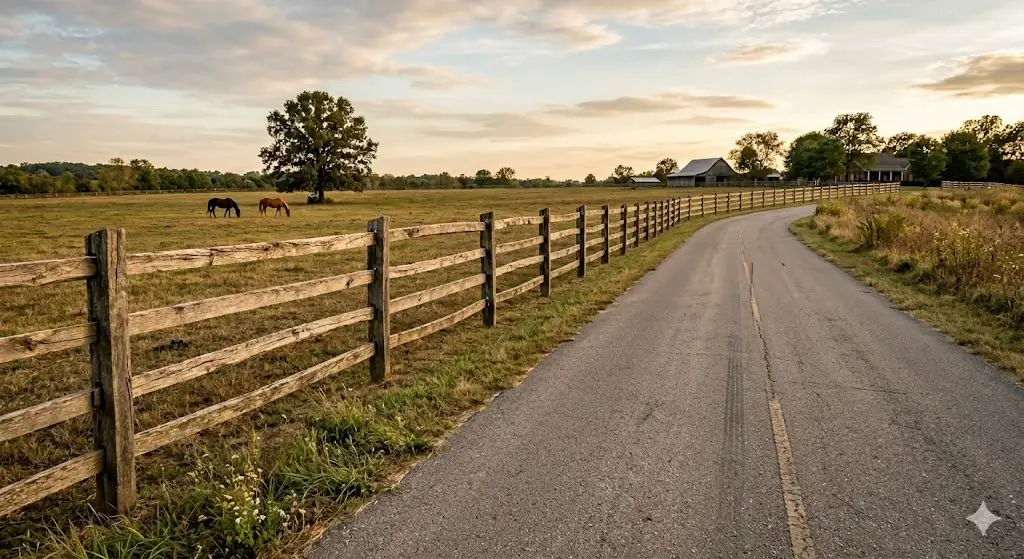
Post-and-board is the classic horse fence and the one most people picture. Wood posts with two, three, or four boards running between them. It is highly visible, which matters, because a horse at speed needs to see the fence before it reaches it. It looks like a farm should look.
The trade-offs are real. Board fence is the most maintenance of the common options: boards crack, fasteners back out, and horses chew and crib on the top rail. It is also the most material per foot, so across a long perimeter it adds up.
Where it earns its keep is around the barn, along the road frontage, and anywhere horses gather and press against the fence. A common approach is board along the visible front and something else out back. See split rail and farm fence for what we build.
Woven No-Climb Wire
If I had to pick one fence for horses, it would be woven no-climb wire with a wood or vinyl top rail. The mesh openings are small enough that a hoof cannot get through and get caught, which is the injury that makes horse people wary of field wire and barbed wire.
Woven wire covers ground efficiently, needs less upkeep than board, and handles pressure well because it flexes instead of breaking. The top rail is not decoration. It gives the fence visibility at horse eye level and keeps the top wire from getting mashed down where animals lean.
The details that make or break a wire fence are bracing and tension. Corners and ends have to be braced properly, because the whole fence pulls against them. A wire fence with weak corners goes slack, and a slack fence is not a fence. This is also where our wet weather comes in: a low spot that holds water will undermine a corner post if the bracing and drainage were not thought through.
Electric, and Where It Belongs
Electric fence is a psychological barrier rather than a physical one, and it works well in the right role. A single hot wire along the inside of a board fence stops horses from chewing and leaning, which extends the life of the board fence considerably. Polytape and polyrope are visible and work well for cross-fencing and temporary paddocks.
What electric is not good at is being your only perimeter fence along a road. When the charger fails, or a limb shorts the line, or the grass grows into it, the barrier is gone and you may not know until the animals are out. Keep electric on the inside of a physical fence where the stakes are high, and use it more freely for interior divisions.
Grounding is the part people get wrong. A charger with a poor ground does not deliver a convincing correction, and animals figure that out fast. Test it regularly, and keep the line clear of vegetation.
Get a free estimate
Call or text Greg at (731) 555-1234, or use the form. Photos of your yard help.
Free on-site estimates in Jackson & West Tennessee.
Match the Fence to the Animal
Different livestock defeat fences differently:
- Horses. Visibility and no-catch openings are the priorities. Woven no-climb with a top rail, or board. Avoid anything a hoof can go through and hang in.
- Cattle. They push and lean rather than jump. Sturdy posts, good bracing, and either woven wire, high-tensile, or a well-built board fence.
- Goats. The hardest animal to fence, because they climb, squeeze, and test constantly. Tight mesh, close post spacing, and often electric assistance.
- Sheep. Woven wire with the right mesh size, and a plan for predators, which sometimes means a hot wire low and outside.
- Keeping wildlife out. Deer pressure is a height problem and a different fence than any of the above.
Tell me what is going in the pasture before we talk material. A fence built for cattle is not the fence I would build for goats, and rebuilding a cross fence because the animals changed is avoidable.
Gates: Build Them Wide Enough
The most common regret on a farm fence is a gate that is too narrow. A gate sized for a pickup is not sized for a tractor with an implement, a hay wagon, or a truck and trailer that has to turn into it off a lane.
Think about the widest piece of equipment that will ever come through, then add margin for the approach angle. A wide gate is one of the cheapest upgrades at install time and one of the most expensive to change later, because it means moving posts and re-bracing.
Where gates go matters too. Corners are convenient to fence and awkward to drive through. Gates set back from the corner, and gates positioned so you can pull straight through rather than jackknifing, save you years of aggravation. Also plan a gate in each cross fence so you can move animals without walking the long way around. Our gate installation and repair page covers farm gates, and if you want automation on the entrance, read the automatic gate systems guide first.
Before Anybody Digs, Call 811
This is state law and it applies on a farm the same as in town. Tennessee requires notifying Tennessee 811 at least three full business days before any excavation, including hand-digging. Locators then have seventy-two hours, not counting weekends and holidays, to mark the lines, and a locate ticket stays valid for fifteen calendar days.
On rural property there are often more buried surprises than people expect: old water lines to a barn, electric to a well pump or a light pole, gas service, and lines that were put in by somebody who is no longer around to ask. A pasture fence is a long row of holes, and hitting a line is a bad day at best.
One more legal note for shared boundaries. Tennessee has a partition fence statute, T.C.A. section 44-8-202 and the sections with it, that deals with boundary fences between rural neighbors and cost sharing in certain circumstances. If your fence is a true boundary fence with a neighbor, that is worth understanding before you build. The property line guide covers more of it.
Common Questions About Farm Fencing
What is the safest fence for horses?
+Woven no-climb wire with a top rail is hard to beat. The mesh is too small for a hoof to get through, the wire flexes under pressure instead of breaking, and the rail gives the fence the visibility a horse needs at speed. Board fence is also safe and looks the part, with more maintenance.
How wide should a farm gate be?
+Wide enough for the widest equipment that will ever use it, plus margin for the turn into it. Size it for the tractor with an implement or a truck and trailer, not for the pickup. Widening a gate later means moving and re-bracing posts.
Do I need a permit for a fence on farmland in Madison County?
+In unincorporated Madison County, a building permit is not required for a standard residential fence seven feet or under under the adopted code. Corner-lot sight rules still apply, and inside any city limits the local ordinance governs. See the permits guide.
Can I use barbed wire around horses?
+I do not recommend it. Barbed wire and horses are a bad combination, because a horse that gets tangled in it injures itself badly. It has a place with cattle on some operations. For horses, woven wire or board is the better answer.
The Honest Bottom Line
On acreage, spend your money on corners, bracing, gates, and the fence that touches the animals. Woven no-climb with a top rail is the workhorse for horses. Board along the road frontage and the barn, where looks and pressure both matter. Electric on the inside to stop chewing and for cross fencing. Build your gates wide the first time.
Walk the property with me and tell me what is going out there. Serving Madison County, Henderson County, and the farms around Jackson. See also the materials guide for how each one handles our weather.
Get a free estimate
Call or text Greg at (731) 555-1234, or use the form. Photos of your yard help.
Free on-site estimates in Jackson & West Tennessee.