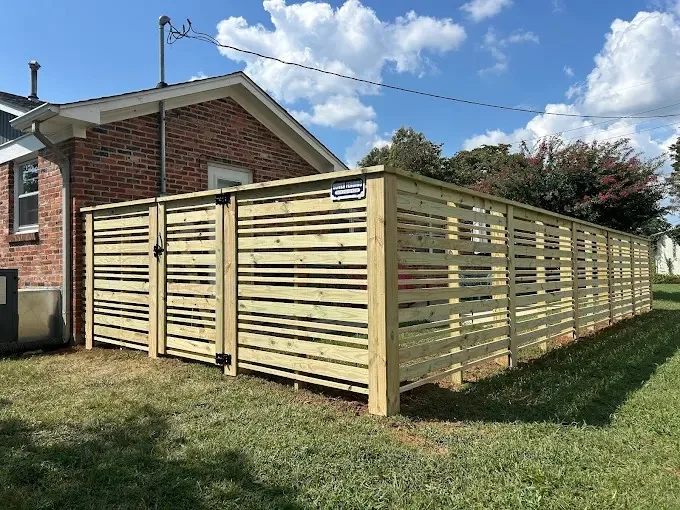
Horizontal Slat and Modern Fence Installation
Boards turned sideways, run flat between the posts. A clean modern line that asks more of the lumber and a lot more of the post layout.
Turning the Boards Sideways Changes the Whole Fence
A horizontal slat fence is the same lumber as a regular wood fence, laid the other direction. The boards run flat from post to post and the posts do all the work. That one change is why it looks modern and why it behaves differently than anything else we build.
Here is what the photos do not show. On a vertical fence the rails span between posts and short pickets just hang on them. Turn the boards sideways and every board becomes a beam. A long board carrying its own weight across a wide gap sags in the middle, and a sagging board in a stack of parallel lines is the most visible defect a fence can have. Everything about the layout comes back to that.
Get a free estimate
Call or text Greg at (731) 555-1234, or use the form. Photos of your yard help.
Free on-site estimates in Jackson & West Tennessee.
Who this fence is for
Horizontal is a style decision first. It suits newer builds, clean rooflines, modern farmhouse exteriors, anywhere a dog-ear stockade would look wrong. It also makes a short fence look longer, because the eye runs sideways instead of counting pickets. Common picks: a side-yard screen, a courtyard, a hot tub enclosure, the stretch you see from inside the house.
It is a bad fit in three cases. If you have a dog that climbs, a horizontal fence is a ladder with the rungs on the inside, which is the problem on the dog fence page. If the line is long and the budget is fixed, the post count will eat it. And if nobody will look at the fence on purpose, a plain privacy fence screens the same yard for less.
One Jackson wrinkle worth raising early. The city ordinance requires the finished side of a privacy fence to face adjacent properties and any public right-of-way. On a horizontal fence the framing is the posts, and they may show on one side or be trimmed out on both. Settle that before the design, not after. See the permits and rules guide.
Span, post spacing, and sag
This is the part a salesman skips. A horizontal board is unsupported between posts, and its own weight pulls the middle down. Wet lumber weighs more than dry, so a board flat on installation day can be bowed by the end of the first humid summer. That is not a defect. It is physics, and you beat it by shortening the span.
So a horizontal fence gets more posts than a vertical one of the same length, and there is no way around it. A vertical fence carries wider spacing because the rails are the beams and are sized for it. Here the boards are the beams, and a fence board is not a good one.
The other levers: thicker boards resist sag better than thin ones, and a thin wide slat is the worst combination and the one that looks best in a catalog. A vertical stiffener behind the boards at mid-run halves the effective span without another post in the ground. Two fasteners per board per post, because one screw lets a board rotate. And straight lumber, selected on the truck, since a crowned board here is a line that does not match the ones above and below it for the life of the fence.
There is also a plumb problem. Posts have to be dead plumb and in line, because the boards telegraph any error along the whole run. On a vertical fence you hide half an inch inside the picket spacing. Here you hide nothing, which means more layout time before the first board goes on.
Material and style choices
- Cedar. The usual pick. Lighter than treated pine, which directly helps the sag problem, more stable in humid weather, and it takes stain evenly so the lines read clean.
- Treated pine. Works, costs less, weighs more wet. In pine we shorten spans further and tell you plainly it has to dry before it gets stained. Both woods are on the wood fence page.
- Gap or no gap. Tight boards give a solid screen. A deliberate reveal gives the slatted look most people picture when they say modern, and lets wind through. A wide reveal is not a privacy fence, and we say so.
- Slat width. Narrow slats look more architectural and take more boards. Wide boards go up faster and read heavier.
- Post treatment. Posts exposed as part of the design, or wrapped so the run looks continuous. Wrapping costs more and looks better.
- Metal posts with wood slats. Steel does not twist or rot at the ground line and holds a straighter line over time, which matters more here than on any other design.
- Aluminum horizontal panels. Want the look with nothing to maintain? Aluminum comes in horizontal profiles that will not cup at all.
Gates need a real frame with a diagonal brace behind the slats, because slats will not hold a leaf square. Then the gate's slat lines have to align with the fence either side, or the gate announces itself every time you walk past. Hardware is on gate installation and repair.
Cupping and twisting in West Tennessee humidity
This climate is the main argument against a horizontal fence, and anybody selling you one without mentioning it is not being straight. Humid subtropical, zone 7b, wet summers and drier falls. A board in that cycle takes on moisture and gives it back, unevenly across its width, because the sunny face dries faster than the shaded one. That difference is what makes a board cup.
On a vertical picket a cup is subtle. On a horizontal board it catches water and holds it the whole length, trough pointing at the sky, and water sitting on wood is how wood fails. So we fasten crown up where the lumber has one, keep boards off the ground, and push for the fence to be sealed on all four sides rather than just the face you look at. Which side gets finished matters more here than on any other fence we build. Timing and prep are on fence staining and sealing.
Twist is the other failure. A board that twists pulls out of plane and breaks the parallel lines. Two fasteners per post is most of the answer and straight lumber is the rest.
On wind, a slatted fence with reveals behaves reasonably because air passes through. A tight horizontal fence is as solid as any privacy fence and catches just as much. Jackson's record includes two F4 tornadoes and an EF4 across the Union University campus, and nothing on a residential lot survives a direct hit. For the ordinary spring storm, what matters is in the ground.
Which brings it back to posts. Gulf Coastal Plain ground capped with wind-blown silt, not rocky limestone. It holds water and moves wet to dry, nudging posts out of plumb over a few seasons, and here that is not subtle because every board in the stack tilts with the post. Deeper holes, footings that cannot lift, somewhere for water to go. See setting fence posts in West Tennessee soil.
What moves the price
No figures here. What changes the number, roughly in order:
- Post count. The biggest difference between this and a vertical fence. Shorter spans mean more holes, more concrete, more layout time.
- Total footage. Still the baseline, and still underestimated. Walk the line before you guess.
- Lumber grade. This design wants straight, stable boards, and selecting for that costs more than taking the stack as it comes. Not the place to save.
- Board thickness and slat width. Thicker resists sag. Narrower slats mean more boards and fasteners per foot.
- Height. More courses of board, longer posts, deeper holes.
- Post wrapping and trim. Finish carpentry, priced like it.
- Gates. A frame behind the slats plus alignment with the runs either side. The fussiest gate we build.
- Grade of the land. The one that catches people. A horizontal fence cannot rack to follow a slope. It steps, and every step is a decision you look at forever.
- Removing the old fence. Separate labor and disposal, on fence removal and haul-away.
Relative terms: horizontal in cedar sits well above a plain wood privacy fence of the same height on post count and lumber alone, and can land near vinyl depending on the finish details. It is not the economy option. The Jackson fence cost guide covers how an estimate comes together.
Maintenance
The finish needs keeping up more diligently than on a vertical fence, because horizontal surfaces hold water and vertical ones shed it. Every top edge is a little shelf. Stain or a penetrating sealer on a cycle, and pay attention to the edges, not just the faces.
The rest is watching for boards that move. Sight down the fence from one end a couple of times a season, looking for a board that cupped, twisted, or dropped mid-span. Catching one is a small job. Letting four go until the run looks wavy is a different conversation. One real advantage here: a single bad board comes out and a new one goes in without touching anything around it, which beats swapping a picket buried in a stockade run.
Keep mulch and soil off the lowest board. Skip the pressure washer. Check the gate each season, because a horizontal gate that starts to rack shows it in the slat alignment before the latch.
On lifespan the design is neutral. What decides it is whether the boards stay sealed and the posts stay plumb. The material comparison is in the fence lifespan guide, and best fence materials for West Tennessee puts it beside the alternatives.
Get a free estimate
Call or text Greg at (731) 555-1234, or use the form. Photos of your yard help.
Free on-site estimates in Jackson & West Tennessee.
Common questions
Do horizontal fence boards sag?
+They will if the span is too wide for the board. Every board is a small beam carrying its own weight, and wet lumber weighs more than dry. The fix is closer post spacing, thicker boards, sometimes a mid-span stiffener, and two fasteners per board at every post. Built on the same spacing as a vertical fence, it sags.
Does a horizontal fence cost more than a vertical one?
+Yes, on post count and lumber selection. Shorter spans mean more posts, and the design only looks right with straight, stable boards, which means picking through material. Wrapping posts and aligning a gate adds more. It is a style upgrade, priced like one.
Can a horizontal fence follow a sloped yard?
+It steps down in sections rather than racking with the ground the way a vertical picket fence can. Stepping leaves a triangular gap under each section, so we fill those, add a longer bottom board, or set step heights to keep the gaps small. On a steep lot this is the first thing to look at.
Will a horizontal fence cup in this humidity?
+Some boards will move, because that is what lumber does in a humid subtropical climate. Cedar moves less than treated pine, thick boards less than thin, and a board sealed on all four sides less than one finished on the visible face only. Here a cup holds water the length of the board, so keeping the finish up matters more.
Is a horizontal fence a good choice with a dog?
+Not if the dog climbs. Horizontal boards on the inside face are a ladder, and a dog that would never clear a smooth privacy fence will walk up a slatted one. Tight boards with no reveal on a fence tall enough for your dog can work. Otherwise put the slats on the outside face or pick a smooth-faced design.
How we build them
We pull a string line before we talk about anything else, because on this design the layout is the job. We look at the slope, decide where the steps fall, pick post spacing off the board you want, and settle whether the posts show or get wrapped. Then you get a written quote naming species, board size, reveal, post spacing, and gate detail.
Tennessee law requires notifying 811 at least three full business days before any digging, hand tools included, so the locate goes in on approval. Posts get set plumb and in line and cure before any board lands on them. Courses go up off a level reference, not off the ground, and the gate gets built to match the run either side.
We build these in Jackson and across Madison County. Want the modern look without the lumber? Ask about metal posts or aluminum. New construction generally is fence installation. Call or text Greg at (731) 555-1234.