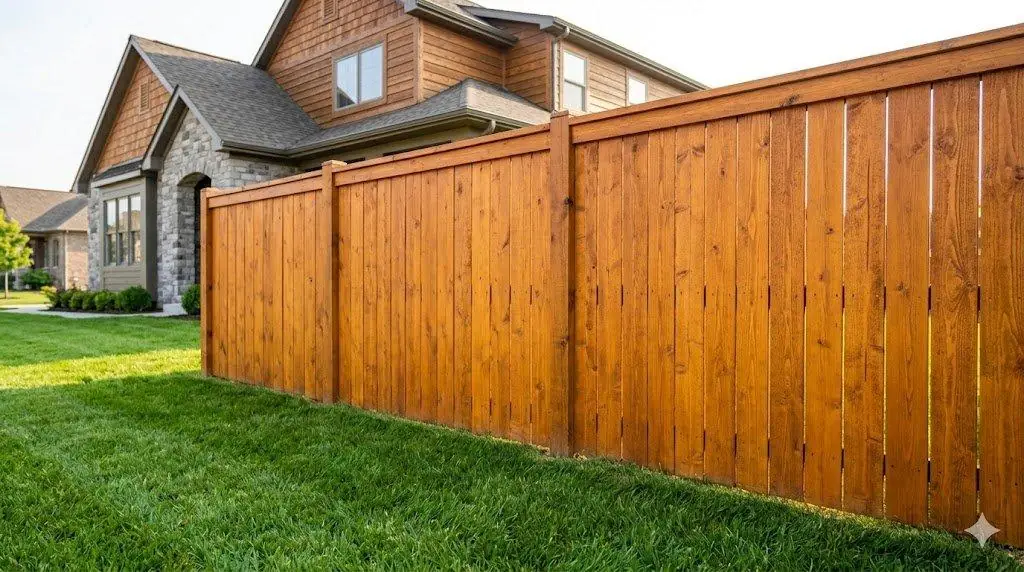
Privacy Fence Installation in Jackson, TN
Solid fence that actually screens the yard, built in wood or vinyl and set for soil that moves.
Privacy Fencing for Jackson and West Tennessee Properties
A privacy fence is any fence built to block the view rather than mark a line. In practice that means solid panels with no gaps, in wood or vinyl, tall enough to screen a yard from the house next door. It's the single most requested fence in Jackson, and it's most of what we build across Madison County.
Two things decide whether a privacy fence does its job. The panel design, because a plain stockade develops daylight gaps as the boards shrink and a board-on-board fence doesn't. And what happens where the fence meets the ground, since a gap under the bottom board defeats the point and invites a dog to test it.
One Jackson rule changes some designs: the finished side of a privacy fence must face adjacent properties and any public right-of-way. Posts and rails end up on your side unless you pick a design finished both ways. Detail in the permit and rules guide.
Get a free estimate
Call or text Greg at (731) 555-1234, or use the form. Photos of your yard help.
Free on-site estimates in Jackson & West Tennessee.
Who a privacy fence is for
The obvious cases: a back yard that looks straight into a neighbor's, a patio or pool deck you'd like to use without an audience, a dog that reacts to everything it can see, and a lot that backs up to a road. A solid fence handles all four, and it cuts some road noise as a side effect, though less than people hope.
It's the wrong choice for a front yard in Jackson. The city ordinance says a fence in a required front yard can't materially impede vision above two and a half feet, and a solid privacy fence plainly would. A picket fence is the front-yard answer. It's also the wrong choice if you want to keep a view, or if the fence line is exposed and you'd rather not own a sail in a windstorm. In those cases an open fence in aluminum or mesh gets you the boundary without the wind load.
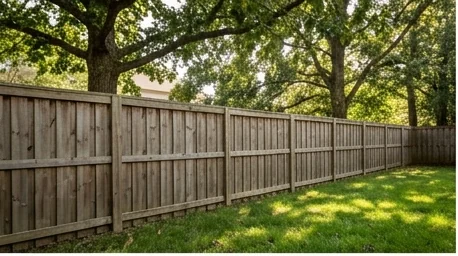
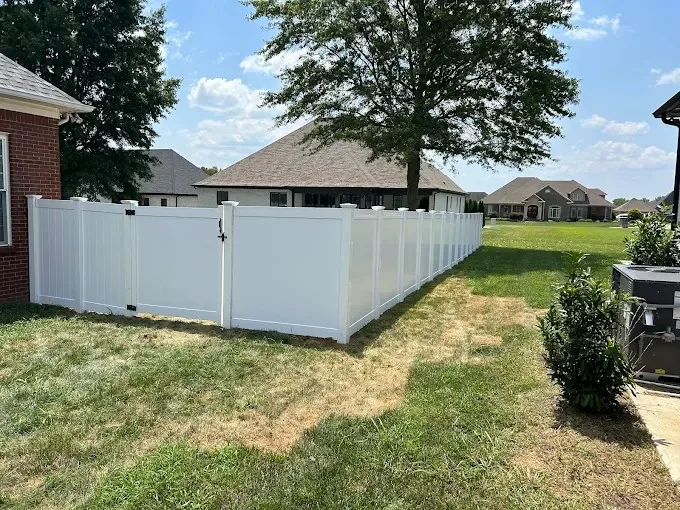
Styles and options we build
All of these screen the view. They differ in how they look from each side and how they age.
- Stockade. Boards edge to edge on one side of the rails. The standard, and the least expensive way to get a solid screen. It will show some gaps as the wood dries.
- Board-on-board. Boards overlapped so shrinkage never opens a gap. More lumber, better long-term screening, and it looks more finished.
- Shadow box. Boards alternating on either side of the rail. Finished from both directions, which solves the good-side rule neatly, and it lets wind through. It gives up some privacy at an angle.
- Vinyl privacy. Tongue-and-groove PVC panels. No staining ever, and no shrinkage gaps. See vinyl fencing.
- Horizontal slat. Boards run flat for a modern look. Wants straight lumber and tighter post spacing.
- Lattice or spindle top. A decorative band across the top section adds height and light without a solid wall.
Two details worth deciding on purpose. A cap and trim board across the top hides the picket ends and makes a fence look built rather than assembled. At the bottom, either hold the boards up off the dirt or run a rot board along the ground that can be replaced on its own. Either beats letting the pickets sit in soil.
How a privacy fence holds up in West Tennessee conditions
In a humid subtropical zone 7b climate, moisture is a solid wood fence's enemy in two places: the ground line, where posts stay damp, and the boards themselves, which swell in the wet months and shrink in the dry ones until fasteners loosen and pickets cup. Vinyl sidesteps both. It also expands with heat, which is why panels float in the post channels instead of being screwed tight.
Wind is the specific risk a privacy fence carries that no other fence does. Jackson's record carries two F4 tornadoes and an EF4, one of them across the Union University campus, and a solid panel catches everything. Nothing survives a direct hit, but post footings with real depth and hardware that holds are what separate losing a couple of panels from losing the line. A shadow box bleeds wind through on purpose, and some vinyl systems release a panel under load so the posts survive. Repair is on storm damage.
The ground is the other half. We're on Gulf Coastal Plain ground, uplands mantled in wind-blown loess. The silt digs easily and drains poorly once compacted, so it holds water and moves through wet and dry cycles. That movement walks posts out of plumb, and on a tall solid fence every degree of lean shows from the back door. Add the wind load a privacy fence carries and footings matter more here than on any other fence. See fence posts in West Tennessee soil.
What it costs, roughly
No per-foot figures here. What moves the number:
- Total footage. The biggest factor, and the one homeowners underestimate most.
- Height. On a privacy fence this drives more than material. Taller means longer posts, deeper footings, more concrete, and often a third rail.
- Panel design. Board-on-board uses noticeably more lumber than stockade for the same run.
- Gates. Each one is its own project, and a solid gate wide enough for a mower or a truck is a real cost.
- Grade. Sloped ground gets stepped or racked, and both are slower than running flat.
- Old fence removal. Pulling an existing fence and its footings adds labor and disposal.
Ranked against each other in this market: chain link is the least expensive fence we build, but it isn't really a privacy fence. Among fences that actually screen, treated pine stockade is the value option, cedar sits above it, board-on-board above that, and vinyl privacy generally lands higher than wood. Ornamental materials are usually the most expensive of all, and they don't give privacy. The Jackson fence cost guide covers how estimates get built, and the privacy fence guide goes deeper on choosing.
Maintenance and how long it lasts
A wood privacy fence needs stain or sealer on a cycle, and it needs staining more often than a fence that gets less sun. Keep mulch and soil pulled off the bottom board, because anything piled against wood holds moisture exactly where it does the most damage. A vinyl privacy fence needs washing and nothing else. Either way, check the gate hardware once a season, since gates take the most wear on any fence.
On lifespan, vinyl outlasts wood here, and cedar outlasts treated pine. Board-on-board outlasts a stockade fence's good looks, since it never develops the gaps. The largest single factor, though, is the post footing. A fence with posts in proper concrete outlasts the same fence tamped into dirt, and given the wind load a solid fence carries here that isn't close. Comparisons in the fence lifespan guide and best fence materials for West Tennessee.
Get a free estimate
Call or text Greg at (731) 555-1234, or use the form. Photos of your yard help.
Free on-site estimates in Jackson & West Tennessee.
Common questions about privacy fence
How tall can a privacy fence be in Jackson?
+The city's published ordinance sets vision-clearance rules for front yards and corner lots but does not state a maximum height for side and rear yards, so we don't quote a number we can't source. The right move is to confirm your height with the City of Jackson planning office, or with Madison County if you're outside city limits, and we'll do that with you at the estimate. In the county, a fence over seven feet triggers a building permit and structural review.
Which side of the fence has to face my neighbor?
+The finished side. Jackson's ordinance requires the good side of a privacy fence to face adjacent properties and public rights-of-way, so your posts and rails face in. A shadow box or board-on-board design is finished from both directions if that bothers you.
Wood or vinyl for privacy?
+Wood costs less up front, looks like wood, and can be repaired a board at a time. Vinyl costs more, needs washing instead of staining, and never develops shrinkage gaps. If you plan to be in the house a long time and don't want a maintenance schedule, vinyl. If budget is the constraint or you want the real thing, wood.
Will a privacy fence block road noise?
+It helps and it won't solve it. A solid fence breaks up and reflects some sound, and the taller and more solid it is the more it does. Real noise reduction takes mass and height beyond what a residential fence provides. Set your expectation at noticeably better, not quiet.
Can I put a privacy fence on the property line?
+You need to know where the line actually is first, and Jackson's permit application asks for a boundary survey or a signed agreement with your neighbor for exactly that reason. Tennessee also has a partition-fence statute covering shared boundary fences and a body of case law on long-standing fence lines. Worth reading fence line and property disputes before you dig.
How we work
You talk to the people setting the posts. We walk the line with you, look at the grade and the drainage, decide where the gates go and how to handle the good-side rule, and hand you a written quote with the material and the panel design named.
Then the utility locate. Tennessee law requires notifying 811 at least three full business days before any digging, hand tools included. After that it's posts, cure time, and panels. New builds on fence installation, gates on gate installation and repair.
Call or text Greg at (731) 555-1234 for a walkthrough.