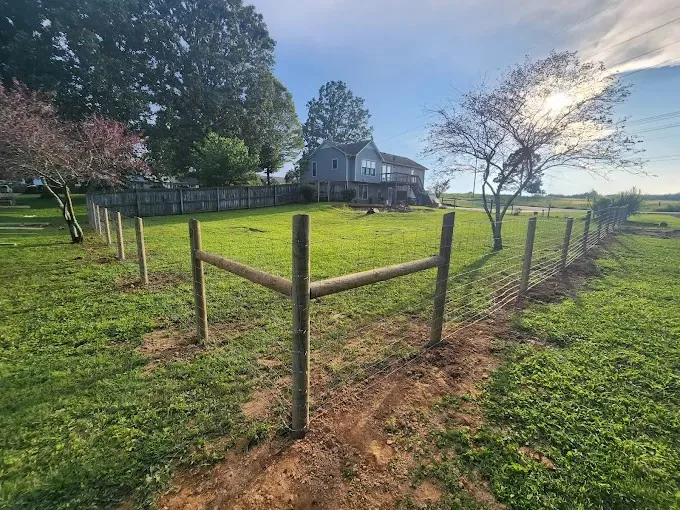
Fence Line Drainage and Erosion
Water decides more about a fence line than the fence does. Here is how to read your own yard before you build across it.
Most fence lines cross water somewhere. Not a creek, usually. Just the path rain takes across the yard on its way off the lot, which nobody thinks about until a fence is standing in it.
Jackson averages a good deal of rain spread across the year, and this is silt country, which means water moves soil readily. A fence built without noticing where the water goes will tell you about it within a few seasons, usually at the bottom of the boards and at the base of two or three posts.
This page is about reading your own yard before you build across it.
Get a free estimate
Call or text Greg at (731) 555-1234, or use the form. Photos of your yard help.
Free on-site estimates in Jackson & West Tennessee.
Find the Water Before You Set the Line
The best time to look at a fence line is during a hard rain, and the second best is right after one. Walk the route you are planning and look for what the water already told you:
- Bare soil channels where grass will not hold. That is a flow path, and it is active.
- Silt fans where soil has been deposited in a sheet, marking where the water slowed down.
- Standing water hours after the rain stopped. That is the low point of the yard whether or not it looks like one.
- Where downspouts discharge, and where that water goes from there.
- Driveway and patio edges, since every square foot of hard surface sheds its rain somewhere.
- The neighbor's slope, because water arriving on your lot is still your fence's problem.
Sketch it or photograph it, then bring that to whoever is quoting the fence. A contractor walking the line in dry weather cannot see any of this, and you can.
Solid to the Ground, or a Gap
This is the central decision on any run that takes water, and both answers are legitimate.
A fence built tight to the ground gives water nothing to pass through, so it dams. Debris and leaf litter pack against it, water backs up on the uphill side, and the fence becomes a small retaining structure it was never designed to be. On a flowing path, water then either finds its way around the end or works soil out from under the panel until it has a channel.
A gap at the bottom lets water and small debris through and keeps the boards out of the wet. The cost is that a gap is an exit for a small dog and an entrance for most wildlife. This is the real tension on almost every fence with a dog in the yard.
The middle answers are worth knowing. A gap sized to the actual flow rather than left random. A run of masonry or a treated kickboard at grade, sacrificial and replaceable, with the fence proper starting above it. Or a switch to an open style on the wet stretch only, with privacy where privacy matters. Mixed perimeters are normal. See the dog fence guide for the containment side and privacy fencing for the screening side.
Bottom Board Rot, and Why It Is Always the Bottom
On a wood fence the bottom rail and the lower ends of the boards fail first, more or less always. Moisture sits there, air moves least there, and grass and mulch bank up against it.
Where the fence sits in a drainage path, that clock runs much faster on that one run. You can usually spot it from the pattern of failure: if one stretch of a fence is soft at the bottom while the rest is sound, water is the reason, not the lumber.
What helps is unglamorous. End grain sitting off the dirt rather than in it. A deliberate gap or a replaceable kickboard. Keeping mulch, clippings, and soil pulled back from the base. And not aiming a sprinkler head at the fence, which is a surprisingly common cause of one run aging out ahead of the others. Our fence lifespan guide covers the rest of the wear picture.
Get a free estimate
Call or text Greg at (731) 555-1234, or use the form. Photos of your yard help.
Free on-site estimates in Jackson & West Tennessee.
Washout at the Posts
The more serious failure is not the boards. It is the soil that holds the posts going somewhere else.
Flowing water in silt scours, and a post that was set correctly can still lean because the ground confining it has washed out. The sequence is usually gradual and then sudden: soil erodes around the collar for a few seasons, and then one heavy rain takes enough that the post moves visibly. You can sometimes see it coming, as a gap or a channel opening up around the base of the concrete.
Concentrated flow does far more damage than general wetness, which is why a downspout discharging near a post or a driveway edge funneling runoff along a fence line is worse than a whole yard that simply drains slowly. Fixing the water is usually cheaper than repeatedly resetting the post. See posts in West Tennessee soil.
Raising the Bottom, Stepping the Fence, or Moving It
When a run genuinely takes water, there are three structural responses and it is worth knowing which is being proposed:
Raise the bottom. Hold the fence above grade on the wet stretch, with the gap sized for the flow. Simplest and often sufficient. The visible tradeoff is that the bottom line of the fence will not be uniform, so it is worth seeing where that transition lands.
Step the fence. On sloped ground, build in level sections that step down rather than racking the panels to follow the grade. Stepping keeps panels square and gives you control over where the gaps under each section end up, which on a slope with runoff is usually the better choice. Racking follows the ground and leaves a consistent bottom, which looks cleaner and gives water less room to pass.
Move the line. Sometimes the right answer is not to build across the channel at all. Pulling a fence a few feet onto higher ground, or up out of the lowest corner, solves the whole problem permanently and costs nothing but enclosed area. It deserves to be on the table before the other two.
Two things to be clear about. We build fences, and we do not do earthwork or drainage installation as a service. Where a yard genuinely needs water rerouted, that is a drainage contractor's work, and doing it first usually produces a better fence. And on a low-lying lot near the South Fork Forked Deer River, there are separate questions to ask the county before anything gets planned. See the floodplain lots guide.
Common Questions About Fence Drainage
Should there be a gap under my fence?
+On a run that carries water, a gap usually makes the fence last longer and reduces washout. If you are containing a dog, that gap works against you. The workable answer is often a gap on the wet stretch and a tighter build where containment matters, or a replaceable kickboard at grade.
Why is only one section of my fence rotting?
+Almost always water. That run sits in a flow path, takes a downspout, or gets hit by a sprinkler while the rest of the fence stays drier. Fix the water source and the repair lasts. Replace the boards only and you will be back.
What happens if I build a solid fence across a drainage path?
+It acts as a small dam. Debris packs against it, water backs up on the uphill side, and eventually it either scours a channel underneath or pushes water somewhere new, which can include a neighbor's yard. Worth designing around rather than discovering.
Do you fix drainage problems as part of a fence job?
+We design the fence around the water and we will tell you plainly what we see on the walk-through. Earthwork and drainage systems are a separate trade, and where a yard needs that done, it is better done before the fence goes in.
The Honest Bottom Line
Water is what takes fences down here, slowly at the boards and permanently at the posts. Walk your line in the rain, mark where it runs, and tell whoever quotes the job. A fence designed around one wet run is a normal fence with one section built differently, and that is a much smaller thing than rebuilding it later.
On the walk-through we look at where water goes as much as where the line goes. Ask us what we found. See fence installation and fence repair, or the materials guide if a wet run is steering your material choice.
Get a free estimate
Call or text Greg at (731) 555-1234, or use the form. Photos of your yard help.
Free on-site estimates in Jackson & West Tennessee.