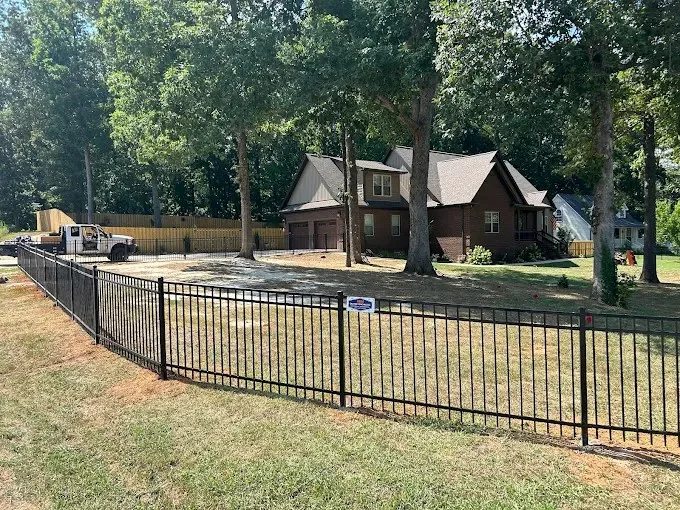
Fences on Slopes and Retaining Walls in Jackson, TN
A sloped lot changes how a fence is built, and a retaining wall adds a second permit. Here is what Jackson requires and what to sort out before the posts go in.
Do I need a permit for a fence on a retaining wall in Jackson? Yes, two. Jackson's building code amendments require a permit for every fence, approved by Planning first, and for every retaining wall, approved by Engineering first. A fence on top of a wall needs both approvals. Call 811 before you dig on the slope.
A flat yard is easy to fence. A slope is where a straight plan meets the actual ground. The fence has to follow the hill somehow, the water running down it has to go somewhere, and if somebody has built a wall to hold the hill back, you now have a fence and a wall competing for the same strip of dirt.
This guide covers the rules that are on paper for Jackson, the soil conditions that make slopes behave the way they do, and the points where I would stop and ask the city before building.
Get a free estimate
Call or text Greg at (731) 240-8701, or use the form. Photos of your yard help.
Free on-site estimates in Jackson & West Tennessee.
Two Walls, Two Permits
The model building code exempts shorter retaining walls from permits, those not over four feet measured from the bottom of the footing to the top of the wall, unless they hold back extra load. Jackson's amendment deletes that exemption and replaces it with a flat rule: all retaining walls within its jurisdiction require a permit, with prior approval from the Engineering Department. In the Construction Guide that amendment sits with the building code changes, and the residential code change lists only small detached buildings and fences, so ask Engineering how it treats a low yard wall at a house.
Fences get the same treatment. The city deleted the model code's exemption for fences not over seven feet, in both its building and residential code amendments. Every fence requires a permit, with prior approval from the Planning Department.
So if you plan to set a fence on top of a retaining wall, you are asking two departments for two approvals. I would not start on either one until both are in hand, because a fence design can depend on what the wall design allows.
What I could not confirm is how the city treats a fence and wall combined, beyond the two approvals above. I also found no height limit written down for a wall or for a fence on a wall. If your plan has a tall wall and a tall fence stacked together, ask Planning and Engineering how they want that drawn up. Do not assume a number.
Moving Dirt Can Trigger a Third Permit
The City of Jackson also has a development permit. The city's Construction Guide says it is required whenever a development involves any form of land disturbance caused by moving earth, or an increase in storm water runoff from decreased soil permeability. When it applies, a soil erosion, sediment and drainage control plan goes to the City Engineer for approval. The Engineer's office can tell you whether your slope work crosses that line, and the number is (731) 425-8220.
The permit is written around earth movement and runoff, not around fences as such. I do not know whether the city counts post holes. But if your slope plan involves cutting a bench into the hill, moving fill, or changing how water leaves your lot, that is the kind of work the wording describes. One phone call settles it before you build, not after.
Why Slopes Behave the Way They Do Here
USDA soil survey data lists Lexington, Feliciana and Smithdale as the most widely mapped soils in Madison County. The USDA's published descriptions of them cover a wide spread of slope, from nearly level to steep. Lexington and Smithdale are well drained, but their runoff ranges from slow to rapid. Grenada, another county soil, has a dense layer below the surface that perches water in late winter and early spring, so water can show up on a slope in the wet months.
Those descriptions are for the soil types, not for your lot. Put them in fence terms as general practice. A post hole on a slope can stay dry in August and weep in March, and water running down the hill tends to follow loose backfill around a post. That is one reason I treat drainage as part of the fence plan, not an afterthought. The drainage and erosion guide goes deeper, and the post-setting guide explains what this ground does to a post.
How a Fence Follows a Hill
These are general trade practice, not code rules. There are two basic ways to handle a slope, and which one fits depends on the fence type.
- Stepped. Each panel stays level and the fence drops in a staircase pattern, one step at a time. Rigid panels like aluminum, iron, and prebuilt wood or vinyl sections usually go this way. The trade-off is a wedge-shaped gap under the low end of each panel.
- Racked. The panel itself follows the slope, tilting to match it. Some picket and board fences can do this. It leaves less of a gap but changes the look of the pickets.
I am not going to tell you one is better, because it is not that simple. It depends on the fence style, how steep the ground is, and what you need the fence to do. A dog that digs, a pool that needs a barrier, and a plain property-line fence all want different answers. This is exactly the kind of thing to settle on a site visit, where I can see the ground.
Get a free estimate
Call or text Greg at (731) 240-8701, or use the form. Photos of your yard help.
Free on-site estimates in Jackson & West Tennessee.
The Gap Under a Stepped Fence Is a Pool Problem
If the fence is also your pool barrier, the stepped-panel gap stops being a looks question. Jackson's adopted pool barrier text limits the gap under the barrier to two inches over grass or gravel and four inches over a solid surface such as concrete, measured on the side of the barrier that faces away from the pool. The top of the barrier must be at least 48 inches above grade. Madison County's adopted text gives two inches. A stepped fence on a slope can open a larger gap on the downhill side of each step, and that fails the rule.
That means a pool on a slope may need the ground shaped up to the bottom of the barrier, or a fence built to follow the slope more closely. Ask the building office which fix it will accept. See the pool fence requirements guide and pool fencing for the rest of the barrier rules.
Corners, Front Yards, and the Wall Exception
Jackson's front-yard rule says no fence may materially impede vision above two and a half feet in a required front yard, and corner lots have a vision-clearance area at the intersection. Madison County, Humboldt and Lexington each say in their own vision rules that the rule does not prohibit any necessary retaining wall. The Jackson text I read has no such sentence, so I will not attribute that exception to Jackson.
If your retaining wall sits near a street corner, ask Planning how the wall and the fence on top of it measure against the vision limits. A wall raises the fence, which raises the stuff drivers can no longer see over. The permits guide has the sight-triangle detail.
Easements and Utilities on a Hill
The city's zoning says a fence placed in a dedicated easement can be removed at the owner's expense if it damages, blocks access, or otherwise impedes the easement. Easements can run along the low edge of a lot, and that is also a common place to want a fence. Check your plat, or ask the city, before you set the first post.
Call Tennessee 811 before digging, too. Tennessee 811 asks for at least three working days of notice, and it counts hand-digging as excavation. A post hole on a hillside is still a hole in the ground.
What I Would Do Before Hiring Anybody
Get your boundary right
The permit asks for a certified survey or a signed neighbor agreement. On a slope, the line matters more, because walls and fences tend to sit close to it.
Call Planning and Engineering
Describe the wall, the fence, and the slope. Ask whether each needs its own approval and whether your plan triggers a development permit.
Walk the water
Go out after a hard rain and watch where it runs. That tells you more about your fence line than a drawing does.
Ask the bidder how the fence follows the ground
Stepped or racked, how big the gaps are, and what happens to the posts on the downhill side. The estimate guide shows what to look for in the write-up.
Common Questions About Fences on Slopes
Can I build a fence on top of a retaining wall in Jackson?
+Possibly, but you need both approvals. A retaining wall requires a permit with Engineering Department approval, and a fence requires a permit with Planning Department approval. Ask both offices how they want a combined wall and fence handled.
How tall can a fence on a retaining wall be?
+I could not find a written height limit for a fence on a wall, so I will not give you a number. The front-yard and corner-lot vision rules still apply. Ask Planning to confirm what applies to your lot before you design the wall.
Does a stepped fence work as a pool barrier?
+Only if the gap under each panel stays within the limit. Jackson's adopted text allows two inches under the barrier over grass or gravel, measured on the side facing away from the pool. A stepped fence on a steep slope can exceed that on the downhill side, so the ground or the fence has to be adjusted.
Do I need to call 811 for a fence on a slope?
+Yes. Tennessee 811 asks for at least three working days of notice before any excavation, and it counts hand-digging. The slope does not change that.
Why do fence posts on a slope seem to lean over time?
+Usually water and gravity. In general, runoff follows the loose soil around a post, and the downhill side has less ground holding it. Good drainage and well-set posts help. The post depth and concrete guide covers how posts get set.
The Honest Bottom Line
A slope does not stop a fence. It adds a few questions and, if there is a wall, a second permit. Get both answers from the city, then pick a fence style that suits the hill. If you are in Jackson and want a second opinion on your lot, see fence installation in Jackson and ask Greg to walk the slope with you.
Get a free estimate
Call or text Greg at (731) 240-8701, or use the form. Photos of your yard help.
Free on-site estimates in Jackson & West Tennessee.
More plain-English answers on cost, permits, materials, and repairs are in all of our fence guides.