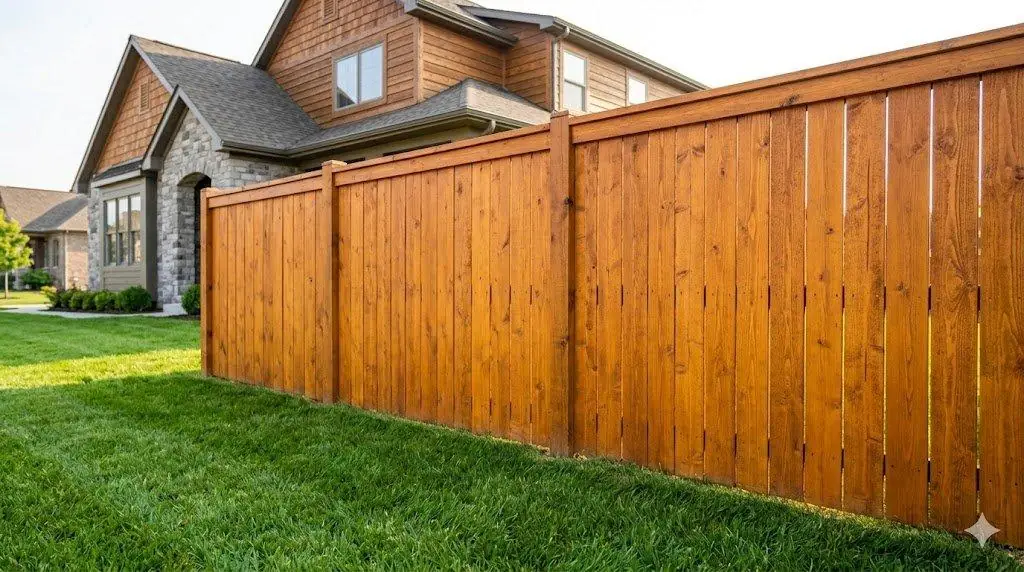
Fence Staining and Sealing in Jackson, TN
The timing is the whole job. Stain wood that is not ready and the finish sits on top and peels, no matter what you paid for it.
Finish Work on a Wood Fence, Done in the Right Order
Staining a fence looks like the simplest thing we do and it is the one people get wrong most often. Not because the technique is hard. Because the timing is, and because nearly everything that goes wrong with a fence finish was decided before the first drop went on the wood.
Three things decide whether a finish lasts: whether the wood was dry enough to take it, whether the surface was clean, and whether the weather cooperated for long enough on either side of the work. Get those right and an ordinary product performs well. Get them wrong and the best product on the shelf will peel off a fence you just paid to build. We stain and seal new wood fence and recoat existing fence in Jackson and across the surrounding counties.
Get a free estimate
Call or text Greg at (731) 555-1234, or use the form. Photos of your yard help.
Free on-site estimates in Jackson & West Tennessee.
When new wood is ready to take stain
This is the question we get most, and the answer is not a date on a calendar. It is a moisture question.
Pressure-treated pine leaves the treatment cylinder saturated, because the preservative is carried into the wood in water. Until enough of that water leaves, there is no room for a finish to get in. Stain on wet treated lumber does not penetrate. It sits on the surface, dries as a skin, and lets go in sheets the first time the board moves. People blame the stain. It was the moisture.
Cedar is different. It usually arrives kiln dried or air dried, so a cedar fence is often ready much sooner, sometimes right away. It does carry natural oils at the surface that can slow a finish, and a light cleaning handles that.
How to tell instead of guessing:
- The water drop test. Sprinkle water on the board. Beads up and sits there, the wood is still full. Soaks in within a minute or so, there is room for stain.
- Weight and feel. Wet treated pine is heavy and cool to the touch. As it dries it lightens and the color fades toward gray.
- A moisture meter. The direct answer, and what we use rather than guess on a fence somebody is paying us to finish.
Now the local part. Humid subtropical, zone 7b, with a lot of water in the air and on the boards. Treated lumber dries slower here than in a dry climate, and that is real rather than theoretical. A fence built going into the wet part of the year is not on the same schedule as one built in a dry stretch. So we test rather than promise. If somebody quotes staining brand new treated pine on the day it goes up, that is a sale, not a plan.
Humidity, dew, and picking the window
The weather on either side of the work matters as much as the wood. What we are watching:
- Dry weather before. Boards dry through the surface, not just dry to the touch. A fence rained on yesterday looks dry by noon and is not.
- Dry weather after. A finish needs to set before it gets wet. Rain on a fresh coat leaves runs in the film or washes penetrating oil out of the wood.
- Dew. The West Tennessee one people forget. On a humid night everything outdoors gets wet, including a fence stained at four in the afternoon. So we start early and stop with daylight left.
- Heat and direct sun. A board in full July sun is hot enough to flash the carrier out of the stain before it soaks in, leaving lap marks and a patchy finish. We follow the shade around the fence.
- Cold. Most finishes have a minimum application temperature, overnight lows included.
So the calendar has good stretches and bad ones, and the good ones are worth waiting for. Our best time to install a fence guide covers the seasonal picture on the build side.
Prep, which is most of the work
Nobody wants to pay for prep and it is where the result comes from. A finish bonds to the surface it touches. If that surface is dirty, gray, or coated in something old, that is what the new stain is bonded to.
On an existing fence, prep means:
- Cleaning. Dirt, pollen, and the gray oxidized layer on weathered wood have to come off, or the stain sits on dead fiber that flakes away and takes the finish with it.
- Removing what is failing. Old coating that is peeling or lifting comes off rather than getting painted over. The single biggest reason a recoat fails.
- Mildew. Our humidity grows it, especially on shaded faces. It gets killed and washed off, not sealed under a new coat where it keeps growing.
- Brightening. Cleaners leave wood blotchy, and a brightener evens the color so the stain lands uniformly.
- Repairs first. Loose boards refastened, rotted ones swapped, gates sorted. Do not finish around a problem you will open back up. That is fence repair.
- Full drying after washing. Everything above put water into the wood, and it has to come back out, which usually means prep and staining are not the same day.
On pressure washing, the honest version: high pressure tears up the soft wood between the grain lines, leaves a fuzzy raised surface, and drives water deep into the board. A cleaner doing the chemical work with low pressure to rinse beats a wand set to blast. If your fence has been washed hard before, that may be why the last finish did not last.
Oil versus film-forming, in general terms
There are two families of product and they fail in different ways, which is the useful way to think about it.
Penetrating oil finishes. These soak in and leave very little on the surface, so there is almost nothing to peel. When one wears out it thins and fades on the sun-exposed areas and the fence starts looking dry. That is an easy failure to live with: clean it, put more on, and the recoat blends. The tradeoff is doing it more often, with less color coverage.
Film-forming finishes. Solid-color stains and paints, building a layer that sits on the wood. Most color, most UV protection, longest stretch between coats. When they fail they crack and peel, and a peeling film has to be stripped before the next coat, which is a much bigger job. They are also less forgiving of moisture in the wood, because water leaving the board pushes the film off from underneath. That matters in this climate.
Semi-transparent, in the middle. Some pigment for UV protection, grain still showing, a thin film at most. What goes on most residential fence here, and a reasonable default.
Pigment is the thing to understand. Clear sealers block water and do very little about sunlight, and sunlight is what turns wood gray. More pigment means more UV protection and longer color. A clear finish on a south-facing fence looks untreated long before a semi-transparent one does. On cedar, plenty of people here like the weathered silver-gray and leave it alone, which is legitimate, and gray is not rot. Keeping the amber takes pigment and recoating.
What moves the price
No figures on a website. What changes the number:
- Square footage, not fence footage. A tall fence is more surface than a short one of the same length, and both faces is double one face.
- How many faces, and whether the tops and bottom edges get done. A shadowbox has pickets on both faces by design.
- Board pattern. A flat stockade sprays fast. A board-on-board has an overlap a sprayer cannot reach behind, and a horizontal slat fence has a top edge on every board. See board-on-board and shadowbox.
- Condition going in. A new fence needs cleaning. A neglected one needs cleaning, mildew treatment, brightening, and maybe stripping, which is most of the labor.
- Old coating to remove. Stripping a failed film finish is the most expensive prep there is.
- Product type and number of coats. Different materials, different coverage per gallon, and a weathered fence drinks more on the first pass.
- Access and what has to be protected. Shrubs, siding, a patio, a pool, and any line you cannot reach without masking everything around it.
- Repairs found along the way. Quoted separately so you see what is finish work and what is carpentry.
Relative to the rest of what we do, finish work is a small job next to building the fence, and it is the cheapest thing you can do to keep a wood fence from becoming a repair. The Jackson fence cost guide covers how estimates come together generally.
How often to recoat
We will not give you a year count, because the honest answer depends on things nobody can see from a website: which product went on, how many coats, which direction the fence faces, and how much shade it gets. What we can give you is the relative picture and what to look for.
The relative part. A penetrating oil needs recoating more often than a semi-transparent, and a semi-transparent more often than a solid color. A west face taking afternoon sun needs it sooner than a shaded north face on the same fence. A fence under trees stays wet longer and grows mildew faster. A horizontal design holds water on every board edge and wants attention sooner than a vertical one.
The signs it is time, which beat any schedule:
- Water stops beading. Sprinkle water on it. If it soaks straight in, the water repellency is gone.
- The color has faded unevenly, lighter on the sun side than the shade side.
- The surface feels dry and chalky instead of slightly slick.
- Mildew coming back quickly after you clean it.
- On a film finish, any cracking or lifting at all. Catch it early and it is a clean, cleanable recoat. Wait and it is a stripping job.
The general rule is that recoating a fence on time is always cheaper than catching it late, and catching it late is always cheaper than replacing boards. How the material choice plays into total life is in the fence lifespan guide.
Get a free estimate
Call or text Greg at (731) 555-1234, or use the form. Photos of your yard help.
Free on-site estimates in Jackson & West Tennessee.
Common questions
How long should I wait to stain a new pressure-treated fence?
+Until the wood is dry enough to absorb the finish, which is a moisture question rather than a calendar one. Treated lumber leaves the plant saturated, and in our humidity it dries slower than it would in a dry climate. Sprinkle water on a board: if it beads and sits, the wood is still full and stain will sit on top and peel. If it soaks in within about a minute, it is ready. We check with a meter rather than guess.
Can I stain a cedar fence right away?
+Often much sooner than treated pine, because cedar usually arrives kiln dried or air dried rather than saturated. Cedar does carry natural oils at the surface that can slow a finish, so a light cleaning first helps it take evenly. Same water test applies. If you prefer cedar weathering to silver-gray, leaving it unfinished is a legitimate choice, and gray is not rot.
Should I use a stain or a clear sealer?
+Depends whether you care about color holding. A clear sealer repels water but does almost nothing about sunlight, and sunlight is what turns wood gray, so a clear-sealed fence looks weathered fairly quickly. Pigment is what provides UV protection. The more pigment, the longer the color lasts. A semi-transparent stain is the middle ground most fences here end up with.
Why did my last fence stain peel?
+Almost always one of three things. The wood was too wet when it went on, so the finish never penetrated and sat on the surface as a skin. Or the surface was not cleaned, so it bonded to dirt and dead gray fiber instead of wood. Or a film-forming product went over an old coating that was already failing. Penetrating finishes rarely peel because there is barely any film to let go.
Can you stain my fence right after you build it?
+On cedar, often yes. On treated pine, usually not, and we would rather come back than put a finish on wood that cannot take it. We schedule the finish work as a second visit once the boards test dry, and we tell you that at the estimate so it is not a surprise. Anyone promising same-week staining on brand new treated lumber is selling, not planning.
How we work and where
We look at the fence before quoting, because the prep is the job and you cannot see prep from a photo. We test the moisture, look for mildew and failing coating, check the boards and gates for anything that should be repaired first, and tell you what product family fits the fence and how you want it to look. Then you get a written quote separating prep, finish, and any repairs.
We stain and seal fence in Jackson, across Madison County, and through the surrounding towns. If the fence turns out to need more carpentry than finish, we will say so instead of painting over it. Call or text Greg at (731) 555-1234.