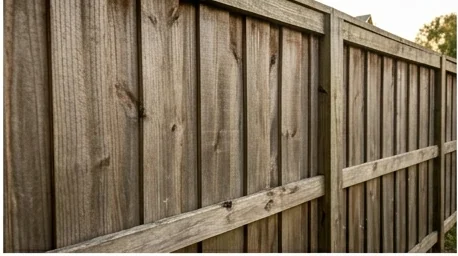
Mildew and Gray Blotches on a Wood Fence in the Humid South
That gray, black-spotted look is not dirt and it is not the end of the fence. Here is what it is, how to clean it, and what keeps it from coming right back.
Why is my wood fence turning gray and blotchy? Usually mildew and other fungi, which grow fast on bare wood in warm, wet weather. Wash with diluted household bleach and detergent, rinse well, let it dry fully, then apply a finish with a mildewcide. Follow the product label.
Picture a fence that is not old. It is a couple of seasons in, maybe less, and it has gone dark gray with black freckles, mostly on the shaded runs. The owner wants to know if it is ruined.
It is not. It is usually fungus growing on the surface layer of the wood, and that is a color problem before it is a structural one. But in a humid climate the lab calls it a particularly serious problem for unfinished wood. It says the fungus does not normally degrade the wood the way wood-rotting fungi do.
What follows is what the U.S. Forest Service's Forest Products Laboratory says about it in its publication on exterior wood in the South, in plain talk, plus what we would do about it on a fence in Jackson. It is a different problem from the cupping and bowing covered in our summer humidity and warping guide.
Get a free estimate
Call or text Greg at (731) 240-8701, or use the form. Photos of your yard help.
Free on-site estimates in Jackson & West Tennessee.
What Is Actually Growing on Your Fence
The lab says the gray color of weathered wood usually comes from fungi and mildew, micro-organisms that grow wherever the wood gets a sporadic supply of moisture. In some cases they can turn wood gray within a year, and they can leave patches that the lab describes as dark gray, blotchy and unsightly.
It also says mildew shows up faster and spreads wider in warm, moist climates like the South, and calls it a particularly serious problem for unfinished wood in humid areas of the South. Jackson is humid subtropical and gets a lot of rain, so that describes this place.
Two things to understand.
- Gray is not always damage. The lab says all wood surfaces eventually turn gray in sun and rain. Some people like that look. It adds that the same micro-organisms can also leave dark spores that give the blotchy, unsightly version.
- Fungus on the surface is not the same as rot in the post. Surface mildew stains the boards. Rot is decay, and it softens wood. If a board is soft under your thumbnail, you have a different problem, and our guide to termites and rot in wood fences covers it.
Where It Shows Up First
The lab says these organisms grow wherever a sporadic supply of moisture is available. On a fence, in general, that points to:
- The shaded side, and any run under trees where sun never dries the boards.
- The lower foot or so of the fence, where rain splashes up and grass stays wet.
- Spots where shrubs, vines or mulch touch the wood and hold damp against it.
- Board faces that sit under a sprinkler's spray.
- Unfinished fences. The lab's wording about unfinished wood is blunt, and a bare fence is the case it describes.
The lab notes that on houses, mildew is most common on walls behind trees or shrubs where air movement is restricted. Look at your own fence and see if a pattern shows up. In general, the worst blotching is where the wood stays damp longest.
How to Clean It
The Forest Products Laboratory describes a simple method for cleaning mildew: a dilute solution of household bleach with detergent, then a thorough rinse with fresh water, then drying before you treat the wood again. For restoring the color of weathered deck wood it describes ordinary household bleach diluted with water, rinsed off, followed by one to two days of drying before any finish goes on.
Mix the cleaner
Ordinary household bleach, diluted in water, with a little detergent. Read the product label for safe handling and ventilation. The lab warns never to mix household bleach with ammonia or with any cleaner that contains ammonia.
Apply and scrub
Work in sections, scrubbing the stained boards with a bristle brush or sponge, which is what the lab describes.
Rinse thoroughly
Fresh water, plenty of it. The lab stresses a thorough rinse. Leftover cleaner does the finish no favors.
Let it dry completely
The lab gives one to two days of drying for deck wood after bleach, and the wood should pass the water-drop test described in our guide to staining a new wood fence before you coat it.
Re-treat
Apply a finish that contains an effective mildewcide. The lab says those work best, and that water-repellent preservatives hold bright color but need renewing.
What Not to Do
- Do not strip wood away. The lab warns that deck cleaners and brighteners can remove some of the wood surface and says not to remove excess wood. In general trade practice, a pressure washer held too close can also damage wood. We are not going to give you a pressure number here, because we have no source for one, and a wrong number can ruin boards. Use less force than you think you need.
- Do not paint over it. The lab says mildew must be killed before wood is refinished, or it will grow through the new coat.
- Do not skip the rinse or the drying time. The lab says to rinse thoroughly and let the wood dry before recoating, and Viance says moisture in wood affects how finish penetrates.
- Do not mix cleaners. Follow the label on whatever product you use, and keep bleach away from ammonia.
Get a free estimate
Call or text Greg at (731) 240-8701, or use the form. Photos of your yard help.
Free on-site estimates in Jackson & West Tennessee.
Keeping It From Coming Back
Cleaning resets the clock. What you do after decides how long it runs.
Finish the wood
Unfinished wood in a humid climate is the lab's example of a serious mildew problem, and a finish with a mildewcide is the answer it points to. Semitransparent penetrating stains and water-repellent preservatives are the types the lab prefers on fences because they do not form a film that cracks. Water repellents need to be renewed, so expect to repeat it. The lab goes further and says wood should not be allowed to weather naturally in the South, because mildew is sure to develop. More on timing is in our staining and sealing service.
Let the fence dry out
Cut back plants that crowd the boards, and keep mulch from piling against the bottom. We are not quoting a study for this one. It is simple cause and effect. Damp feeds mildew, and anything that holds damp against wood feeds it. Aim sprinklers at the lawn, not the fence.
Open up the shade where you can
As general practice, if a low limb hangs right over the fence, trimming it can let in more sun and air. Keep clear of power lines, and leave anything near them to the utility.
Look every spring
In general, light mildew is easier to deal with than a heavy buildup, so a yearly look is worth the few minutes.
When Cleaning Will Not Fix It
If the boards are soft, split, or crumbling, cleaning will not help, and a finish will not either. At that point the question is repair or replacement, and we cover how to decide in repair or replace a fence in Jackson. If a few boards have given out and the posts are sound, fence repair is usually the answer. The wood fencing page explains the species and treatment that last longest here.
Quick Check Before You Clean
Spend a minute on the fence before you pick up a brush.
- As a rule of thumb, not a lab test, press a screwdriver tip into a stained board. If it stays firm, you are likely looking at surface mildew. If it sinks in, suspect rot.
- Look at the bottom of the posts. Soft wood there means the problem is deeper than the surface.
- Note which runs are worst, and why. Shade, sprinklers and plants touching the boards are usual suspects. Fix the cause, or you will be back with the brush next year.
- Check the forecast. Rinsing and drying go better in dry weather.
Common Questions About Mildew on Wood Fences
Is the black stuff on my fence mold or mildew?
+It is a surface fungus either way. The Forest Products Laboratory says the gray and dark blotchy color of weathered wood usually comes from fungi and mildew. We do not try to sort out the exact species. What matters is that it is cleanable and that it comes back where wood stays damp.
Can I clean a fence with bleach?
+The Forest Products Laboratory describes diluted household bleach with detergent, then a thorough rinse and full drying time, as a method for mildew. Follow the label on your product, ventilate, never mix it with ammonia, and keep it off plants where you can.
Will a pressure washer do the job?
+It can, and it can also tear up the wood. We do not give a pressure setting because we do not have a source we trust for one. Gentle is the rule. Heavy pressure can fuzz the surface and remove wood you cannot put back.
Why is only one side of my fence stained?
+Often shade and moisture. The side that gets less sun and holds water longer tends to grow fungus first. Plants touching the boards or a sprinkler pointed at them have the same effect.
How soon after cleaning can I stain?
+When the wood is completely dry. For deck wood the lab mentions one to two days of drying after bleach, but weather decides. Use the water-drop test and wait if drops bead up.
The Bottom Line
A blotchy gray fence is a maintenance item, not a failure. Wash it, let it dry, treat it, and keep the damp away from it. If you are planning a new fence, think about the finish up front, because bare wood is where mildew gets its start. Our Jackson fence installation page is a good place to start the conversation.
Get a free estimate
Call or text Greg at (731) 240-8701, or use the form. Photos of your yard help.
Free on-site estimates in Jackson & West Tennessee.
More plain-English answers on cost, permits, materials, and repairs are in all of our fence guides.