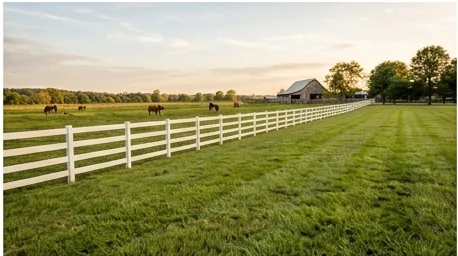
No-Climb Horse Fence Installation in West Tennessee
Woven mesh with openings too small for a hoof to pass, topped with a rail the horse can see. The fence we put up when the animal matters more than the look.
The Mesh Size Is the Whole Point
No-climb fence is woven wire made to one specification that matters above all others: the openings are small enough that a horse cannot put a hoof through them. That is not a marketing detail. It is the reason the product exists, and it is the difference between a fence that contains a horse and a fence that injures one.
Think about what a horse does at a fence. It paws, it strikes, it reaches over for grass and comes down with a front foot on the wire. A shod foot with a heel and a clip on it is a hook. Put that foot through a field-fence opening and pull back, and the wire closes on the pastern above the hoof. What follows is a panicked animal with a thousand pounds of leverage against a strand of steel. Shrink the opening below hoof width and the foot has nowhere to go. That is the mechanism, and everything else here is secondary.
Get a free estimate
Call or text Greg at (731) 555-1234, or use the form. Photos of your yard help.
Free on-site estimates in Jackson & West Tennessee.
Why this over the alternatives
Horse people usually arrive at no-climb after ruling out the other options, so here is the honest comparison.
- Barbed wire. Built for cattle, whose hide and reflexes handle it. A horse hitting it at speed does not stop, it goes through, and the wire opens it up. We do not recommend it anywhere horses are kept, and never on a residential lot.
- High-tensile smooth wire. Strong, cheap per foot, hard for a horse to see, and a horse running a fence it cannot see will hit it. It also stores energy, so a strand breaking under tension whips. Cattle ground and marked interior divisions, not horse perimeter.
- Field fence and welded wire. Field fence openings are large enough to trap a hoof, which is the whole problem. Welded wire snaps at the welds instead of flexing. Neither belongs around horses.
- Board fence. Highly visible and safe when maintained. It is also the highest-maintenance fence on a farm, a horse will chew it, and a broken board leaves a splintered end at chest height. Plenty of people run board along the road and no-climb elsewhere. See split rail and farm fence.
- No-climb woven mesh. Openings a hoof cannot enter, wire that flexes rather than breaking, no sharp points, and it covers ground efficiently. Its one weakness is visibility, which is what the top rail is for.
If you keep cattle instead of horses, or you are fencing large acreage where hoof safety is not the driver, the whole calculation changes and you want farm and field wire fence instead. The general horse-property overview is in our farm and horse fencing guide.
Height, and the top of the fence
Height on a horse fence is not about jumping. Most pastured horses do not try. It is about where the top sits relative to the animal's chest, because a fence low enough to lean over gets leaned over, and a horse reaching over for grass puts its weight and front feet somewhere you do not want them.
So the top wants to be at chest height or better, and it wants to be something the horse registers as a barrier. Mesh alone is nearly invisible at a distance, especially in flat light, and a horse trotting a line does not see wire. That is why almost every no-climb fence we build gets a top rail.
The top rail does three jobs. It gives a visible line at eye level. It takes the weight when the animal leans, instead of letting that load mash the top wire down. And it shields the top edge of the mesh, which otherwise gets bent over and stays bent. Wood, vinyl, or pipe all work. What you should not do is run no-climb with a bare top and expect it to stay square.
Sizing to the animal matters too. A pony and a warmblood do not need the same fence, and a foal can get a leg through a gap an adult cannot. Tell us what is going in the field, including anything being weaned or turned out young. Below the rail, the mesh should run close enough to grade that nothing rolls under, and no strand of barbed wire belongs along the bottom of a horse fence.
Gate widths, and where gates go
On a horse property the gate is where people get hurt, and it is where most of the design mistakes live.
Start with width. A gate has to be wide enough that a led horse does not feel pinched, because a pinched horse rushes, and a rushing horse in a narrow opening is how a handler gets crushed against a post. Then wide enough for the equipment: a tractor with an implement is far wider than a truck, and the widest thing entering that field sets the size. A gate barely wide enough gets clipped, then bent, then replaced.
Other gate rules worth building in:
- Put the gate where the horses do not gather. Gates in corners collect animals and turn into a crowding point. A gate along a straight stretch, away from the feed area, moves traffic better.
- Two gates on a paddock where you can. One to move animals, one to get equipment in without walking a machine past a horse.
- Latch that works from horseback and from the ground, one-handed. And one a horse cannot work with its lips, because some of them can and will.
- No gaps at the hinge or under the leaf. A gap beside a gate post is a leg trap. A sagging gate leaves one.
- Gate posts are the heaviest posts on the property. A wide gate hanging on an undersized post walks it out of plumb in a season, and then the gate does not latch and somebody props it.
Hardware and hanging details are on gate installation and repair, and if the driveway entrance needs to open on a keypad that is automatic gate installation.
What West Tennessee does to a horse fence
Two things here are specific to the ground and the weather, and they both show up at the same place: the corners.
A woven wire fence is a tensioned system, stretched between braced assemblies, with all that pull landing on a handful of posts. Our uplands are Gulf Coastal Plain ground capped with wind-blown silt, which holds water and moves wet to dry. A braced corner standing in ground that softens every spring gets pulled slowly toward the middle of the run, tension drops across the whole fence, and slack mesh is what lets a horse lean the top over and push a shoulder through. That is a containment failure, not a cosmetic one. So corners get set deeper, braced properly rather than just bigger, and put where water will not stand on them. See setting fence posts in West Tennessee soil.
Low ground is the second issue. Plenty of pasture here is bottomland, and the South Fork of the Forked Deer River runs through the Jackson area. A mesh fence crossing a drainage catches every stick that floats down and becomes a dam, and then the water takes the corner out. A crossing gets built to give and be reset rather than to hold. A fence inside a mapped flood hazard area also needs a separate development permit. See fencing floodplain lots.
On coating, galvanized mesh lasts a long time out here. It goes first at cut ends, staple holes, and anywhere the coating got scraped during the stretch, and humidity finds those spots. A long-life coating class is worth the difference on a fence you do not want to re-stretch. Wind barely registers on open mesh. What takes farm fence out here is falling timber along a tree line, which is a repair. See storm damage.
What moves the price
We do not publish numbers, and on farm work the spread between two jobs the same length is wider than on anything else. What actually changes it:
- Total footage. Dominant on pasture work, since the runs are long.
- Number of corners and ends. This is the one people miss. Every corner and every gate opening needs a braced assembly, and those are the expensive posts. A field with five corners costs more than a straight run of the same length.
- Mesh specification. Opening size, wire gauge, and coating class all change what comes off the roll and what it costs.
- Top rail choice. Wood board, vinyl rail, or pipe. Each prices differently and each maintains differently.
- Height of the fence. Taller mesh, longer posts, deeper holes.
- Gates. Count them and size them honestly. Wide gates and heavy pipe gates are a real line item.
- Grade of the land and access. A line that needs brush cut off it first, or ground a machine cannot reach, takes more time.
- Removing old wire. Pulling decades-old fence out of a fencerow that has grown into trees is slow, and it is separate from the new build. See fence removal and haul-away.
In relative terms: no-climb mesh with a top rail costs more per foot than plain field wire and less than a full board fence of the same length. Its running cost is lower than board, because there is nothing to paint. The Jackson fence cost guide covers how we build an estimate.
Keeping it safe
A no-climb fence asks less than board but it is not a fence you ignore, and the maintenance is mostly keeping tension in the mesh. Walk the line and look for slack, and when you find it, check the braced assemblies first, because slack mid-run almost always traces back to a corner that moved.
The rest of the walk:
- Push on every corner and gate post. Those carry the load and they are the ones that fail.
- Look at the top rail for chew damage and cracked boards. A splintered board at chest height is a hazard, not a cosmetic issue.
- Check staples and clips. Too tight cuts into the wire, too loose lets the mesh ride.
- Pick up wire. Scrap in a pasture is a vet bill waiting to happen. Anything we cut goes out with us.
- Keep vegetation off the fence, especially with a hot wire inside it. Grass grown into an electric line takes the charge down without telling you.
Galvanized mesh on good corners is one of the longer-lived fences on a farm here. A wood top rail wants repainting or replacing before the wire does, which is the tradeoff for a visible top. Material by material is in the fence lifespan guide.
Get a free estimate
Call or text Greg at (731) 555-1234, or use the form. Photos of your yard help.
Free on-site estimates in Jackson & West Tennessee.
Common questions
What makes a fence no-climb, and why does it matter for horses?
+The openings in the woven mesh are small enough that a horse cannot get a hoof through them. That is the entire design purpose. A horse that paws at a fence or reaches over it and comes down on the wire can put a foot through an ordinary field-fence opening and then cannot get it back out. Shrinking the opening below hoof width removes the trap.
Can I use barbed wire or high-tensile wire around horses?
+We do not recommend either as horse perimeter fence. Barbed wire tears a horse open rather than stopping it, and a horse hitting it at speed goes through. High-tensile smooth wire is hard for a horse to see, which is exactly how a horse runs into it, and a strand that lets go under tension whips. Both are cattle solutions being asked to do a horse job.
Do I need a top rail on a no-climb fence?
+We push for one on every horse fence. Mesh by itself is nearly invisible to a horse at a distance, so the rail gives the fence a line the animal can see at eye level. It also takes the weight when a horse leans rather than letting that load mash the top wire down, and it shields the top edge of the mesh from getting bent over permanently.
How wide should a pasture gate be?
+Wide enough that the widest piece of equipment that has to get into that field goes through without clipping a post, which usually means sizing to a tractor with an implement rather than to a truck. It also needs enough room that a horse being led through does not feel pinched, because a horse that rushes a narrow opening is dangerous to whoever is on the lead. We measure the equipment at the walkthrough.
Do I need a permit for a horse fence in Madison County?
+In unincorporated Madison County a building permit is not required for a standard residential fence 7 feet or under, and taller than that triggers a permit and a structural review. The county building department is at (731) 423-6014. Inside the Jackson city limits a fence permit is required. Corner-lot sight-line rules apply in both, and a fence inside a mapped flood hazard area needs a separate development permit. We confirm what applies to your address before quoting. See the permits guide.
How we build them
We walk the whole line and ask what is going in the field before we talk wire, because the animals set the specification. Then we lay out corners and gates, since on a wire fence those decide the cost and the strength. You get a written quote listing the mesh spec, top rail, post spacing, brace assemblies, and every gate width.
Tennessee law requires notifying 811 at least three full business days before any digging, hand tools included, so the locate goes in first even on acreage. Braced corners cure before any wire pulls against them, because tensioning green concrete is how a corner ends up leaning. Then the mesh gets stretched, stapled, and topped, and the gates get worked until they latch clean.
We fence horse property in Jackson, across Madison County, and out through the surrounding counties. Call or text Greg at (731) 555-1234 and tell us how many head and how much ground.