Fencing a Floodplain Lot Near the Forked Deer River
What moving water does to a fence, which designs survive it, and the one phone call to make before you plan anything.
The South Fork of the Forked Deer River runs through Jackson. There's a USGS gauge on it right here in town. If your property sits low, near a creek, or anywhere in the river's corridor, a fence is a different project than it is on a flat subdivision lot, and the difference is not about materials. It's about what happens when water moves.
FEMA maps special flood hazard areas across Tennessee, and a property either falls inside one or it doesn't. We're not going to guess which yours is, and we're not going to name neighborhoods, because flood mapping is parcel-specific and it gets revised. What we'll do is tell you how to find out and how to design a fence that survives being underwater.
Here's the one thing to take from this page if you read nothing else: before you plan a fence on a low-lying lot, ask the county floodplain administrator whether your project needs a floodplain development permit. We're not asserting that it does. We're telling you to ask, because a fence in a mapped flood hazard area is the kind of thing that can require its own review, and the people who know are at the county.
Get a free estimate
Call or text Greg at (731) 555-1234, or use the form. Photos of your yard help.
Free on-site estimates in Jackson & West Tennessee.
Find out whether you're in a mapped flood zone
Some ways to check. Your mortgage or insurance paperwork, since a flood zone determination was likely made when you bought. FEMA's public flood map tool, searched by address. And the county, which is the authoritative local answer.
The Madison County Building Department is at 100 E Main St, Suite 100 in Jackson, and the number is (731) 423-6014. Ask for the floodplain administrator or ask who handles floodplain development review for your address. If your property is inside Jackson city limits, ask the city as well, since you're also pulling a city fence permit either way. Our permit guide covers the city side.
What to ask, specifically: is this parcel in a special flood hazard area, does a fence require a floodplain development permit here, and are there restrictions on the type of fence. Write down the answers and who gave them to you.
What moving water does to a fence
Standing water is a maintenance problem. Moving water is a structural one, and people underestimate the difference badly.
A solid privacy fence in a flood is a dam. Water pushes against the full face of it, and a run of solid panel has an enormous surface area. The panel either blows out, which is the lucky outcome, or it takes the posts with it. That's how a whole fence line ends up flat in one direction after a flood, and it's why a solid fence is the worst design choice on a lot that floods.
Debris makes it worse. Floodwater carries branches, trash, and whole logs, and they catch on a fence. Once debris packs against a solid panel, the effective surface area goes up and so does the load. A fence that would have handled the water alone fails because of what the water brought with it.
Then there's what happens underneath. Moving water scours soil, and West Tennessee silt moves readily, so a sound post can still fail because the ground holding it went downstream. Our post-setting guide covers why. There's also the liability nobody thinks about: a fence that blocks flow can push water somewhere it wasn't going, including onto a neighbor. That's part of why floodplain rules exist.
Designing a fence water can get through
The principle is simple. On a lot that floods, you want the fence to let water pass rather than fight it. Ideas worth discussing with whoever builds yours, subject to whatever the county tells you is allowed:
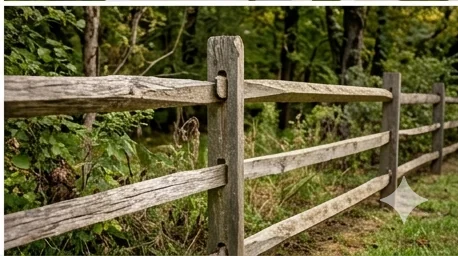
- Open styles rather than solid. Chain link, ranch rail, split rail, and ornamental picket all let water and most debris through. This is the single biggest design decision on a flood-prone run. Chain link in particular is common on low ground for exactly this reason. See chain link fencing and split rail and farm fence.
- Clearance at the bottom. Leaving space between the bottom of the fence and the ground, where the fence's purpose allows it, gives low water and small debris a path. This conflicts with containing a dog, so it's a tradeoff to talk through rather than a rule.
- Breakaway panels. Sections designed to release under load rather than tear out the posts. The idea is that you replace a panel after a flood instead of rebuilding a whole run. It's a design approach worth asking about on a run you expect to go underwater.
- Fewer, stronger posts on the wet run, more replaceable infill. The posts are the expensive part. Protecting them by making the infill the sacrificial element is usually the better economics.
- Don't fence the lowest ground at all if you don't have to. Sometimes the right answer is to pull the line back to higher ground and accept a smaller enclosed area. It's worth putting on the table.
- Corrosion-resistant hardware. Anything that spends time submerged wants galvanized or better.
Materials on a lot that floods
Wood tolerates water reasonably well if it's rated for it and if the fence lets water through. Solid wood privacy on a flooding lot is the combination to avoid. Treated posts rated for ground contact are the baseline, and the base of a post spends a lot of time wet on this kind of ground.
Chain link handles flooding as well as anything. Galvanized mesh and steel posts don't rot, and the mesh passes water. Debris still catches in the mesh, so expect to clean it out after a high-water event.
Vinyl is a system, and a solid vinyl privacy panel has the same dam problem as solid wood, plus some systems crack under impact rather than releasing. Open vinyl rail styles behave better.
Ornamental aluminum passes water and won't corrode, which is a good combination here. Worth asking how the panels attach, since that determines whether a section can be replaced independently. See aluminum fencing and best materials for West Tennessee.
How we approach a flood-prone lot
First question we ask is whether you've talked to the county. If you haven't, that's step one and we'll wait on it. Building first and asking later on a mapped floodplain is not a mistake we want to be part of.
Then we walk the property looking for where water goes, not just where the line is. Low spots, existing scour, debris lines from past high water, which direction things were pushed. That evidence tells us more than a map does about what your specific lot experiences.
Then we design to it: an open style on the wet runs, stouter posts, replaceable infill, and often a different fence on higher ground where privacy actually matters. Mixed-material perimeters are normal here. Our fence installation services page covers the process, and the Madison County page covers rural work.
Questions about fencing in a flood zone
Do I need a special permit to build a fence in a floodplain?
+You may. A floodplain development permit can apply to work in a special flood hazard area, and a fence is the kind of project that can trigger review. We're not going to tell you it definitely applies to your parcel. Ask the county floodplain administrator, reachable through the Madison County Building Department at (731) 423-6014, and get the answer for your specific address.
What's the best fence for a lot that floods?
+An open style that lets water and debris through. Chain link, ranch rail, split rail, and ornamental picket all work far better than a solid privacy panel, which acts like a dam and tends to take its posts with it when it fails.
Can I still have privacy on a flood-prone property?
+Often yes, by putting the privacy fence on the higher ground near the house and an open style on the low runs. That's a common layout on these lots and it usually gives people the screening they actually wanted without putting a solid panel where the water goes.
Will my fence survive a flood?
+Depends on the design and the event. An open fence with well-set posts often comes through high water needing debris cleared and a few sections straightened. A solid fence in moving water frequently doesn't. We'd rather build something that's repairable after a flood than something that claims to be flood-proof.
The honest bottom line
If your lot floods, the fence has to be designed for it, and the design that survives is the one water can get through. That's the whole idea. Everything else is detail.
Make the county call first. Once you know what's required and what's allowed, we can build something sensible for the ground you actually have. Related reading: the post-setting guide for what this soil does, and the storm damage guide for the wind side of the same problem.
Get a free estimate
Call or text Greg at (731) 555-1234, or use the form. Photos of your yard help.
Free on-site estimates in Jackson & West Tennessee.