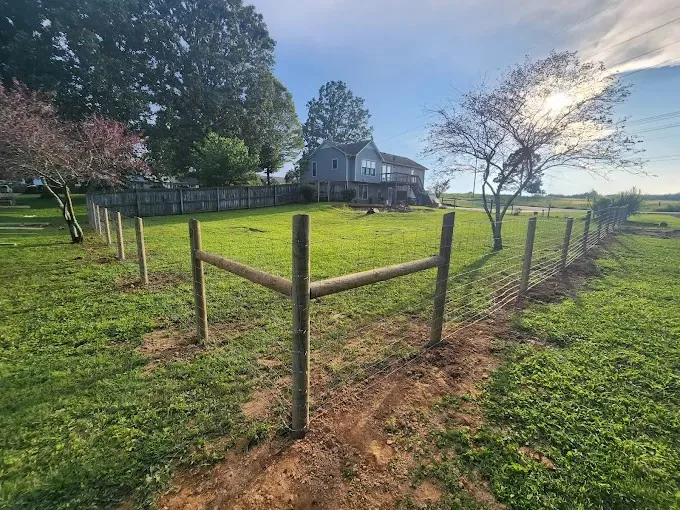
Farm and Field Wire Fence Installation
Woven, welded, and high-tensile wire on braced assemblies. On a wire fence the corners do the work and the line posts just hold the wire up.
Three Kinds of Wire, and They Are Not Interchangeable
People say wire fence like it means one thing. It means three, and picking the wrong one is the most common mistake on a farm fence around here. What you are containing, how much ground you are covering, and how much you want to touch it later all pull in different directions.
The other half of this page is the part nobody thinks about until the fence goes slack: a wire fence is a tension structure. The line posts do almost nothing except keep the wire off the ground. All the real load lives in the corners, the ends, and the gate openings. Build those right and the fence stands for decades. Build them wrong and it does not matter what wire you bought.
Get a free estimate
Call or text Greg at (731) 555-1234, or use the form. Photos of your yard help.
Free on-site estimates in Jackson & West Tennessee.
Woven, welded, and high-tensile
Woven wire. Wires wrapped around each other at every crossing rather than joined. The wrap is a hinge, so the fence flexes when an animal pushes and springs back instead of failing. Most woven field fence is graduated, with smaller openings near the bottom, putting the tight mesh where young stock are. The workhorse for cattle, goats, and general containment. Mesh with openings too small for a hoof is a separate spec: no-climb horse fence.
Welded wire. Same grid, joined by a weld at each crossing. Stiffer, tidier, cheaper in farm-store roll sizes. The weld is the weakness: a rigid point in a structure that needs to flex, and when a cow leans on it the welds pop and the grid starts unzipping. Fine for a garden enclosure, a small pen, or a kennel run. Wrong for a pasture perimeter, and we say so rather than sell it.
High-tensile smooth wire. Stiff high-strength strands strung with real tension and kept tight with in-line tensioners. The least expensive way to cover long distances, very low maintenance, good with cattle. Two cautions: animals cannot see it well, so it wants markers or a top board on any line stock will run, and it stores serious energy, so a strand that breaks whips. Not horse perimeter, for the visibility reason.
Barbed wire is a modifier rather than a fence: a strand or two added at the top for cattle. Cattle ground only. Not around horses, and not on residential property.
Corners and braces: where the fence actually lives
Remember one thing off this page. A wire fence pulls on itself, and everything it pulls against is at a corner, an end, or a gate. Those carry standing tension every day, forever. A single fat post in a hole does not resist that: it rotates slowly toward the middle of the run and the whole fence goes slack behind it.
So corners and ends get built as assemblies, not posts:
- H brace. Two posts set apart with a horizontal member between them and a diagonal wire tensioned across, so pull on one post is transferred to the other. The standard, and what you see on the photo at the top of this page.
- Double H. Two in series where the pull is long or the ground is soft.
- Floating or diagonal brace. One post with a diagonal timber angled back into the line. Less material, and it needs ground that holds the foot of the diagonal.
- Corner assembly. A corner pulls two directions at once, so it gets braced both ways. Half-bracing a corner is a job you do twice.
Two rules we do not bend. Corner and gate posts go deeper and bigger than line posts, always. And brace wire gets tensioned after the concrete cures, never green, because pulling on a fresh footing is how a corner starts leaning on day one. The cost math follows: a field with many corners costs more than a straight run of the same footage, which is why we move a proposed line to cut the corner count.
Stretching, and what it looks like done right
Stretching separates a fence from a roll of wire nailed to trees. Woven wire comes off the roll with its crimps flattened, and it has to be pulled until they take their shape back. Under-stretch it and the fence bellies mid-run and an animal finds the belly. Over-stretch it and you pull the crimp out entirely, losing the spring the fence needs and loading the corner you just built.
What the work involves:
- Pulling with a proper clamp across the full height, not off the top wires, so tension is even top to bottom.
- Stapling only after the pull. Staples driven early fight the stretch, and one tight enough to bite the wire creates a break point.
- Splices that hold. A knot or a crimp sleeve. A twisted-together splice is where a fence lets go, and stock will find it.
- Following the contour. Wire held down into dips and kept from lifting over rises. Fence that bridges a low spot leaves a gap goats and calves treat as a gate.
On high-tensile the same ideas apply with a spring gauge instead of judgment, and in-line tensioners left in so it can be retightened later without rebuilding.
Cross-fencing
The perimeter keeps stock on your place. Cross-fencing is what makes the place work: rotating grazing, resting ground, separating animals that should not be together, holding a sick or new animal where you can get to it. On most farms we fence, the interior divisions do more for the operation than the perimeter does.
Cross-fence can be built lighter than perimeter and it should be, because doing every internal line to perimeter standard will stop you doing it at all. The perimeter is the serious fence, and interior divisions use lighter wire, wider spacing, or hot wire on step-in posts where the layout may change. What cross-fencing does need is more gates than people plan for: a way to move animals to the next paddock without running them through a third, and a way to get a tractor in. Hardware is on gate installation and repair, the livestock picture is in our farm and horse fencing guide, and wood options are on split rail and farm fence.
How wire fence holds up on West Tennessee ground
Our uplands are Gulf Coastal Plain mantled in wind-blown silt. It digs fast, which is good news on a job with a hundred holes in it, and drains poorly once packed, so it holds water and moves through the seasons. On a wire fence that does not show as a wavy line. It shows as lost tension, because the ground gives a braced corner just enough room to rotate, a little more every spring. That is why corners go in deeper and braced rather than just bigger, and why the fences that stay tight here are the ones whose corners were overbuilt. Detail is in setting fence posts in West Tennessee soil.
Bottomland is the other problem and it is worse on wire than on anything else. The South Fork of the Forked Deer River runs through the Jackson area and a lot of pasture here takes water. A woven wire fence across a drainage is a strainer: sticks, then stalks, then a whole tree, and once it is a dam the water takes the corner with it. A crossing gets built to give and be reset, with a floodgate section or releasable wire, rather than a rigid run you rebuild every few years. A fence inside a mapped flood hazard area also needs a separate development permit. See fencing floodplain lots.
On the wire, the enemy is humidity plus damaged coating. Galvanized sits out here a very long time untouched, and fails at cut ends, staple holes, and wherever the coating got scraped during the stretch. Coating class is worth paying up for, and careless stretching costs you life you already paid for. Wind barely registers on open wire, which is a quiet advantage. What takes farm fence out here is timber falling along a fencerow, and that is a repair. See storm damage and fence repair.
What moves the price
No figures, and on farm wire the spread between two jobs the same length is wider than anything else we build. What drives it:
- Corner, end, and gate count. Number one, ahead of footage. Every braced assembly is several times the material and labor of a line post.
- Total footage. Still the baseline on long runs.
- Which wire, and what coating. Woven, welded, and high-tensile are different products at different prices, and coating class changes the number inside any of them.
- Post material and spacing. Wood versus steel, and how tight you space them. Closer costs more and holds wire better on rolling ground.
- Height and strand count. Taller mesh, or more strands on high-tensile.
- Gates. Count every one and size to the widest implement, not the truck.
- Grade of the land and access. Rolling ground takes more posts to hold wire to the contour.
- Clearing the line. A fencerow grown up in brush gets walked and cut first. We do not clear land or take down trees, so timber is somebody else's job before we start.
- Old wire coming out. Slow, separate work. See fence removal and haul-away.
Relative to the rest: high-tensile is the least expensive way to cover long distances, woven field fence sits above it, no-climb mesh with a top rail above that, and full board fence or steel pipe at the top. The Jackson fence cost guide walks through how an estimate gets built.
Maintenance
A wire fence is low maintenance, not no maintenance, and the job is one habit: walk it and look for slack.
When you find slack, do not start at the slack. Start at the nearest braced assembly, because that is almost always the cause. A rotated corner or a loosened brace wire shows up as a belly fifty yards away, and retightening the wire without fixing the corner just moves the problem. On high-tensile with in-line tensioners, a few turns puts it back, which is one of the strongest arguments for that system.
The rest of the walk: staples and clips, splices working loose, the bottom wire where it crosses low ground and where animals push under, and vegetation off the line if anything is hot. Pick up every piece of scrap wire. Wire in a pasture is a vet bill waiting to happen, and anything we cut goes out with us.
A galvanized woven fence on properly braced corners is one of the longest-lived things on a farm here, and the corners are still what decides it. Welded wire in a pasture is the short end. Comparison in the fence lifespan guide.
Get a free estimate
Call or text Greg at (731) 555-1234, or use the form. Photos of your yard help.
Free on-site estimates in Jackson & West Tennessee.
Common questions
What is the difference between woven wire and welded wire fence?
+Woven wire is wrapped at every crossing, so the joint flexes when an animal pushes and springs back. Welded wire is joined by a rigid weld, and welds pop when livestock lean on them. Once one lets go the grid comes apart. Woven for pasture and perimeter, welded only for small pens and kennel runs.
Why do corner posts cost so much more than line posts?
+Because a wire fence is a tension structure and the corners hold all of it. A corner is a braced assembly of two or more posts with a horizontal member and a tensioned diagonal, set deeper than anything else on the fence. Line posts only keep the wire off the ground. That is why a field with many corners costs more than a straight run the same length.
Is high-tensile wire a good choice for my pasture?
+For cattle over long distances, yes. Cheapest way to cover ground, holds tension a long time, and in-line tensioners let you retighten without rebuilding. Two cautions: animals do not see smooth wire well, so it needs markers or a top board on any line stock will run, and it stores a lot of energy. Not horse perimeter.
Why is my wire fence going slack in the middle of the run?
+Usually a corner, not the wire. Our ground holds water and moves as it dries, letting a braced assembly rotate a little each season toward the middle of the line. Tension drops behind it and you see the belly. It can also be an under-stretched build or a creeping splice. We start at the corners.
Do I need a permit for a field fence in Madison County?
+In unincorporated Madison County a building permit is not required for a standard residential fence 7 feet or under, and taller triggers a permit and structural review. The county building department is (731) 423-6014. Corner-lot sight-line rules apply within 100 feet of an intersection out in the county, and a fence inside a mapped flood hazard area needs a separate development permit. We confirm what applies to your address before quoting. See the permits guide.
How we build them
We walk the whole line, and on farm work that is a real walk, not a look from the driveway. We locate corners, find the low spots and crossings, check what the fencerow has grown up in, and ask what the fence has to hold. Then we lay it out to cut corner count without giving up usable ground, and you get a written quote listing wire type and coating, post material and spacing, every braced assembly, and every gate width.
Tennessee law requires notifying 811 at least three full business days before any digging, hand tools included, and that applies on acreage too. Braced assemblies go in first and cure before anything pulls against them. Then the wire gets stretched, stapled after the pull, spliced properly where a roll ends, and the gates hung and worked. Scrap wire and old posts leave with us.
We build farm fence across Madison County, around Jackson, and out through the surrounding counties. Call or text Greg at (731) 555-1234 and tell us the acreage and what is going on it.