Matching a New Fence Section to an Existing One
What can be matched, what only time will fix, and when patching a run stops being the cheaper answer.
Somebody backed into the fence, or one run finally gave out while the rest is fine. The question is always the same: can you make it match.
The honest answer splits in two. Structure can be matched exactly, almost always. Appearance cannot be matched immediately, ever, and whether it converges later depends entirely on the material.
Knowing which of those two you are dealing with is what keeps you from paying for a patch you will be unhappy looking at.
Get a free estimate
Call or text Greg at (731) 555-1234, or use the form. Photos of your yard help.
Free on-site estimates in Jackson & West Tennessee.
Wood: The Color Gap Closes, Slowly
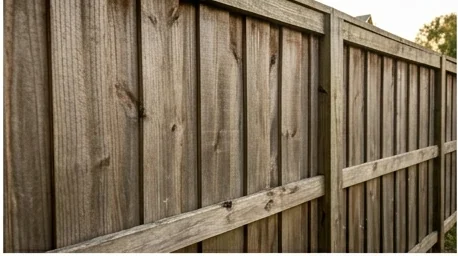
New wood next to weathered wood is obvious. There is no trick that hides it on day one. What matters is that wood is the material where the gap actually closes, because the new boards keep aging and the old ones have largely finished.
How long depends on exposure. A sunny south-facing run grays faster than a shaded one, and how much water that stretch takes changes the pace too. Expect seasons, not weeks.
If the existing fence was stained, that is different, and generally better. Matching a stain on new wood is guesswork because the same product reads differently on fresh lumber than on a fence several years old. The reliable approach is to stain the new section along with the runs on either side of it, which puts the transition somewhere your eye is not looking for it. See fence staining and sealing. Treated lumber also needs time before it will take stain, which is covered in the wood movement guide.
Vinyl and Aluminum: It Is About Availability, Not Skill
Panel systems are either matchable or they are not, and nothing in between. If the manufacturer still makes your style, in your color, with your rail profile, the repair disappears completely. If they discontinued it, no amount of care produces a match.
Manufacturers revise product lines regularly. Rail profiles change, picket spacing changes, and whites drift between product generations, which is why two white panels from different years can look slightly different side by side.
There is also fading to account for. Vinyl and powder-coated aluminum both change over years of West Tennessee sun, so a genuinely identical new panel can still read newer than its neighbors. Ask for a photo comparison before ordering, and ask where the section is going. A patch on a side run nobody looks at is a different decision from one across the front of the house. See vinyl fencing and aluminum fencing.
The Dimensions That Have to Carry Through
This is the part homeowners do not know to ask about, and it is where a bad patch announces itself from across the yard. Appearance aside, these have to line up:
- Board or picket width. Lumber dimensions change over time, and a run of slightly narrower boards changes the rhythm of the whole fence.
- Board thickness and profile. A thinner board sits differently against the rail and casts a different shadow.
- Picket top. Dog-ear, flat, gothic, french gothic. Mixing tops is the single most visible mismatch there is.
- Rail count and rail height. Two rails against three changes where the fasteners land and how the fence reads from the frame side.
- Post spacing. Old fences were not always built to a consistent spacing, so a new section sometimes has to adopt the odd spacing already there.
- Overall height, and how the bottom follows the ground. Whether the old run was stepped or racked to the slope sets what the new section has to do.
Send photos when you call, including one straight down the line and one close up of a rail and picket top. Most of these questions get answered off those two pictures.
Get a free estimate
Call or text Greg at (731) 555-1234, or use the form. Photos of your yard help.
Free on-site estimates in Jackson & West Tennessee.
When a Blended Repair Is Realistic
Patching is usually the right call when the damage is local and the rest of the fence has real life left. Concretely, that means the posts through the rest of the run are sound, the profile is still available or the material will weather together, and the section is not the first thing visitors see.
A few tactics genuinely help. Put the new material where the eye goes least, like a side run rather than the back line you look at from the kitchen window. Break the transition at a corner or a gate, since a change at a direction change reads as intentional. And when you have salvageable old boards, they can be swapped forward into the visible stretch while the new boards go where they are not on display.
When a Whole Run Is the Better Answer
Sometimes patching is the expensive choice dressed up as the cheap one. Replace the full run when:
- The posts are going through that stretch. New panels on tired posts is most of the labor of a new fence with none of the life. Our repair or replace guide walks the post checks.
- The profile is discontinued and the section is somewhere you will look at every day.
- You have patched the same run repeatedly. Several separate repairs in a few seasons is the fence telling you something.
- The old material has gone brittle. Dried-out wood and sun-degraded vinyl both break where you fasten to them, so a patch tends to spawn the next patch.
- You want a different style anyway. Going from spaced picket to board on board is a rebuild, not a match.
One middle path worth knowing: replacing one complete run, corner to corner, often looks far better than a partial patch inside a run, even though it costs more. A whole side that is uniformly new reads as deliberate. Three new boards in the middle of an old panel never will. See fence repair and fence installation.
Common Questions About Matching a Fence
How long until new fence boards match the old ones?
+Seasons rather than weeks, and it depends on sun and moisture on that particular run. Unstained wood converges reasonably well over time. Stained wood is faster to blend if you restain the new section together with the runs on either side.
What if my vinyl fence style is discontinued?
+Then the choice is the closest available panel, placed where it shows least, or replacing a whole run so the difference lands at a corner. We will show you the comparison before ordering anything rather than after it is installed.
Can you match a fence somebody else built?
+Yes, and it makes no difference who built it. What matters is the dimensions and whether the material is still made. Photos of the rail, the picket top, and the full line answer most of it before anybody drives out.
Is it cheaper to patch a fence or replace a section?
+A patch is cheaper today and not always cheaper over a few years, particularly when the posts in that run are near the end. Ask for both numbers and the post assessment that goes with them, then decide with the real comparison in front of you.
The Honest Bottom Line
Structure matches. Color does not, at first. Wood eventually closes the gap on its own and stain closes it faster, while vinyl and aluminum come down entirely to whether the style is still manufactured.
What you want from any contractor is to be told before the work which of those you are getting. If the match is going to be visible, you should hear that while you can still choose the whole-run option instead. Send photos and we will tell you which one you are looking at. See wood fencing or the fence styles guide for what is out there.
Get a free estimate
Call or text Greg at (731) 555-1234, or use the form. Photos of your yard help.
Free on-site estimates in Jackson & West Tennessee.