Chain Link vs. Wood Fence in West Tennessee
A straight comparison with no thumb on the scale, because the right answer depends on what the fence is for.
This comparison usually gets written by somebody who wants to sell you wood. Here's the version that doesn't, because we build both and the right answer is whichever one fits the job.
The short version: chain link contains things and lasts a long time with no upkeep. Wood screens things and looks like a yard instead of a kennel. Those are different jobs. Most people know which one they actually need within about thirty seconds of being asked directly.
Here's the longer version, category by category, with an honest winner in each.
Get a free estimate
Call or text Greg at (731) 555-1234, or use the form. Photos of your yard help.
Free on-site estimates in Jackson & West Tennessee.
Privacy: wood, no contest
Chain link is a mesh. You can see through it and so can everybody else. Slats woven through the mesh reduce visibility and they do not create privacy, and anybody who tells you otherwise has not stood next to one. Privacy screening fabric is a temporary-feeling solution that flaps and fades.
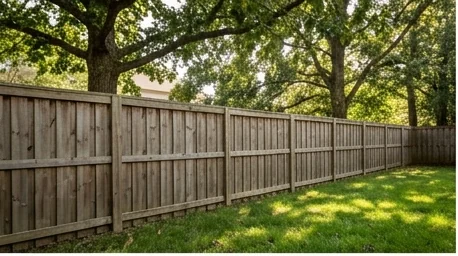
Wood, built as a privacy fence with boards butted tight or overlapped board-on-board, gives you an actual visual wall. If the reason you want a fence is that you can see into your neighbor's kitchen or they can see onto your patio, this comparison is already over. Go read privacy fencing.
Maintenance: chain link, easily
Galvanized chain link does not need stain, seal, or paint. It doesn't rot. It doesn't warp in a humid Jackson August or cup after a wet spring. Barring physical damage, you install it and you leave it alone. Vinyl-coated chain link adds a color finish that can eventually chip or fade at the coating.
Wood needs you. A wood fence in this climate wants cleaning and re-sealing on a regular cycle, and the wet-to-dry swing here is hard on it. Boards cup and warp. Fasteners work loose. Wood in contact with soil at the base of a post is the number one failure point on a wood fence.
The honest caveat on both sides: wood that's actually maintained holds up well. Wood that gets installed and then ignored for a long stretch looks and performs exactly as bad as you'd expect. Be truthful with yourself about which homeowner you are. The fence lifespan guide covers what each material asks for.
Containment: depends on what you're containing
Chain link is better for a climber and a digger of small stature, if you set the bottom tight to grade or use a bottom tension wire. It's also better for keeping things out, because you can see what's on the other side of it.
Wood is better for a dog that reacts to what it sees. A visual barrier stops the fence-line running, the barking at every passerby, and the general agitation that a see-through fence encourages.
Chain link is worse for a jumper that uses the mesh as a foothold. Wood is worse for a digger, since the bottom of a wood fence typically leaves more to work with unless you add a kickboard. Our dog fence guide gets into this properly.
Wind and storms: chain link
Wind goes through chain link. A solid wood privacy fence is a sail, and in a West Tennessee spring storm that's the difference between a fence that loses a couple of boards and a fence that loses a whole run. Part of why chain link holds its place on exposed rural runs is that it survives things.
Wood can be built more wind-tolerant with a shadowbox or spaced design, trading some privacy for airflow, and with tighter post spacing. That's a real option on an exposed run. The storm damage guide covers how each one fails.
Repairs: roughly even, differently
Wood repairs are simple and granular. A broken board is a board. A rotted picket comes off and a new one goes on with a drill. You can fix a wood fence a piece at a time forever, and the only aesthetic issue is that new boards look new next to weathered ones for a while.
Chain link damage is usually a whole-section proposition. A bent top rail gets replaced. Mesh that's been torn or pulled loose from the tension bands gets restretched or swapped. Less frequent, but less piecemeal. Either way, see fence repair.
Looks: wood, for most residential yards
We'll be direct. In a Jackson neighborhood, a wood fence looks like a fence and a chain link fence looks like a boundary. Wood takes stain, can be capped and trimmed, and reads as part of the house. Chain link reads industrial no matter what you do with it.
Where that flips: acreage, a back line against a field or a treeline, a utility area, a garden enclosure, a ball field, or anywhere the point is function. Nobody looks at a chain link fence around a pasture and thinks it's the wrong choice.
And if you're in a subdivision with an HOA, this may be decided for you. Chain link is frequently prohibited where it's visible from the street. Check before you compare. See the HOA guide.
Cost: different brackets, and we won't put numbers on it
Chain link is the lighter-ticket option per foot for a standard residential install, which is a big part of why it's still everywhere. Wood costs more upfront and then asks for maintenance money on an ongoing basis.
We're not publishing figures, and not because we're being coy. Post count, gates, grade, access, and how much old fence has to come out move the number far more than material choice does on a lot of jobs. A per-foot number from somebody who hasn't seen your yard is arithmetic, not a quote. The fence cost guide explains what actually drives it.
Which one fits your job
Simple version:
- Pick wood if privacy is the reason you're fencing, if the fence is visible from the street in a residential neighborhood, or if your dog reacts to what it sees.
- Pick chain link if containment is the reason, if the run is long and out of sight, if you want to spend nothing on upkeep, or if the run is exposed to serious wind.
- Pick both if your property has different runs doing different jobs. This is what we'd suggest more often than people expect. Wood across the sides and back of the yard where you live, chain link along the far boundary nobody looks at.
- Pick neither if what you actually want is the open look with durability, in which case ornamental aluminum is the material you're circling around, or a split rail or farm fence on acreage.
Common questions
Is chain link cheaper than wood?
+For a standard residential install, chain link is generally the lighter-ticket option per foot, and it costs nothing to maintain afterward. Wood costs more to install and asks for upkeep spending over time. Site conditions, gates, and removal of an old fence can shift the totals more than the material does, which is why we quote after walking the property.
Which lasts longer, chain link or wood?
+Galvanized chain link generally outlasts wood in this climate with no maintenance at all, because there's nothing to rot. A well-built, properly maintained wood fence lasts a long time too. An unmaintained one does not. We won't give year counts, because post setting and upkeep swing the answer enormously. See the lifespan guide.
Can you make chain link private?
+Not really. Slats reduce visibility and don't create privacy. If privacy is the goal, build a privacy fence. If you already have chain link and want privacy, the honest options are replacing the run or planting something.
Can I use chain link and wood on the same property?
+Yes, and it's a sensible plan on a lot of Jackson properties. Put the material where it earns its keep. We make the transition at a corner or a gate post so it reads intentional. HOA rules may limit where chain link can go, so check those first.
The honest bottom line
Nobody regrets chain link on a back pasture line and nobody regrets wood along a patio. The regret shows up when the material was picked on price alone and the fence doesn't do what the homeowner wanted.
So tell us the job, not the material. We'll walk the line, we'll tell you where we'd put which, and if the answer is the cheaper material we'll say that too. More detail on each: chain link fencing and wood fencing, or start with best fence materials for West Tennessee.
Get a free estimate
Call or text Greg at (731) 555-1234, or use the form. Photos of your yard help.
Free on-site estimates in Jackson & West Tennessee.