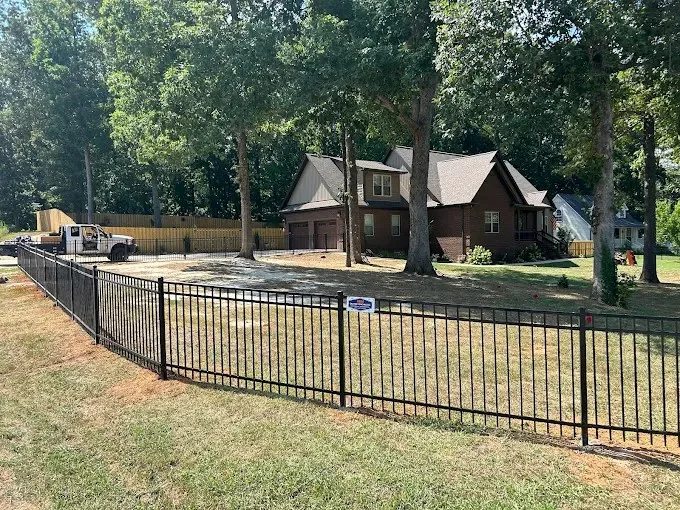
Tennessee's Pool Alarm Law and Your Pool Fence Are Two Different Rules
One rule says the pool needs an alarm. Another says the yard needs a barrier. Meeting one does not satisfy the other, and the two come from different places.
Does Tennessee's pool alarm law replace the pool fence requirement? No. The alarm law (Katie Beth's Law) is a state statute requiring an alarm on pools installed after January 1, 2011. The fence or barrier rules, with their 48-inch height and 4-inch openings, come from the adopted building code. A pool can need both.
People mix these two things up. One person says Tennessee requires an alarm. Another says it requires a fence of a certain height "by state law." Each has half of it, and the missing half is worth finding out about before you build.
The reason is simple. There are two separate sets of rules, written by different bodies, enforced at different points, and neither one is a substitute for the other. This page lines them up side by side so you can tell which is which.
Get a free estimate
Call or text Greg at (731) 240-8701, or use the form. Photos of your yard help.
Free on-site estimates in Jackson & West Tennessee.
Rule One: The Alarm Is a State Statute
Tennessee Code Annotated sections 68-14-801 through 68-14-807 are known as Katie Beth's Law. They are about alarms. The summary in the Madison County Construction Guide says these sections "require an alarm on any swimming pool installed or substantially altered on or after January 1, 2011." It adds that "a municipality may not issue a permit for construction or substantial alteration of a swimming pool unless the project calls for an alarm."
The statute's own wording is a little different from that summary, so here it is. Section 68-14-804 puts the duty on the buyer: anyone who purchases or acquires a swimming pool "to be installed after January 1, 2011" has to install and maintain a pool alarm before using the pool or making it available for use. The permit rule sits in section 68-14-805. It bars a local government from issuing a building permit for the construction or substantial alteration of a swimming pool located at a residential dwelling unless the project calls for a functioning alarm to be installed before the work is finished. Another subsection tells the electrical inspector not to give final approval on the pool wiring, when an electrical inspection is required, until a hard-wired alarm is in or the pool's acquirer shows written proof that a battery-operated alarm was bought. I read this wording in a Wilson County development services handout that reproduces the statute, and in a legal-code site's copy current as of early 2024. Neither is the official code, so check the current text before relying on a detail.
The law does not apply to public swimming pools or multi-family residential housing swimming pools. Its own definition of a residential dwelling is a one-family or two-family dwelling structure.
Note what the statute does not do. It does not describe a fence. It does not set a height, a gate or a latch. It is about a device that sounds when something enters the water.
Rule Two: The Barrier Is a Building Code Requirement
The fence numbers people quote come from a different document. They are in the adopted 2018 International Residential Code, Appendix G, section R326, as reproduced in the Madison County Construction Guide. The City of Jackson's guide has its own wording of the barrier section with the same basic numbers. For an outdoor residential pool, the county's text asks for:
- A barrier at least 48 inches above grade, measured on the side facing away from the pool.
- No more than 2 inches of clearance between the ground and the bottom of the barrier.
- No opening that passes a 4-inch sphere.
- Gates that open outward, close on their own and latch on their own, with the release mechanism positioned so a small child cannot reach it from outside.
There are mesh rules too. In the county's text, chain link openings may not exceed 2-1/4 inch squares unless slatted down to 1-3/4 inch, and lattice openings are limited to 1-3/4 inch. The City of Jackson's guide is stricter on chain link, with a 1-3/4 inch cap, and adds a few details of its own, such as a clear zone around the barrier. Our hot tub fence guide lists those.
None of that is in the alarm statute. It is local enforcement of a model code the county and city adopted. That matters because it can be amended, and because a different town can adopt a different version, or write its own. The full gate and climbing rules are in our guide to pool fence requirements in Tennessee.
Side by Side
- Where it comes from. The alarm is Tennessee statute. The barrier is the adopted building code.
- What it requires. The alarm detects entry. The barrier keeps people out of the yard around the pool.
- Who it covers. The alarm statute is about pools installed after January 1, 2011 (the county's summary adds substantially altered pools) and excludes public and multi-family pools. The barrier text is written for residential pools at one- and two-family homes.
- When it bites. The alarm rule is tied to permitting, since a local government may not issue the pool permit unless the project calls for an alarm. The barrier is a separate part of the adopted code that the building department applies.
- How deep the water has to be. The two definitions differ. In the statute copies I read, the alarm law defines a swimming pool as a structure intended for swimming or recreational bathing that holds water over 36 inches deep, including hot tubs and nonportable spas. The county's building code definition uses more than 24 inches.
- Can one stand in for the other. No. An alarm does not make a fence legal, and a fence does not make an alarm optional.
Where the City of Jackson Fits In
Jackson requires a permit for pools over 24 inches deep, and its construction guide carries a barrier section. The statute bars a permit for a pool at a house unless the project calls for an alarm. My reading is that the pool permit is where the alarm comes up, and the barrier is a separate piece of work with its own paper. Ask the city to confirm.
The fence has a permit of its own. Jackson requires a permit for every fence, with Planning Department approval, and the application asks for a certified boundary survey or a neighbor's signed agreement. How that process runs is in our Jackson fence permit step-by-step guide. The general rules are in fence permits in Jackson and Madison County.
Humboldt writes its own pool enclosure rule. Its municipal code asks for a fence or wall at least 5 feet high, with no opening larger than 4 inches, and requires a building inspector's permit before the enclosure is built. As written, that is stricter on height than the county's 48 inches, though the code lets Humboldt's building inspector make modifications in individual cases. If you live in Humboldt, the city's code is the one that governs your fence. I did not look at how Humboldt handles the state alarm statute.
I cannot tell you whether Medina, Milan or Trenton enforce the barrier text the same way, because I have not found their pool rules in print. Medina's zoning, for one, is held at the city recorder's office. Call and ask.
One Mistake Worth Skipping: The Wrong Statute
Some websites cite Tennessee Code section 68-14-502 as the state's pool fence law. It is not. That section defines terms for bed and breakfast establishments, and it says nothing about pools or barriers.
If a contractor, a blog or an insurance form hands you that citation, ask for the source. The alarm law is sections 68-14-801 through 68-14-807. The barrier numbers are building code.
Get a free estimate
Call or text Greg at (731) 240-8701, or use the form. Photos of your yard help.
Free on-site estimates in Jackson & West Tennessee.
What I Cannot Tell You
The honest part of this page is the list of things the sources I used do not settle. I would rather say so than hand you a confident guess.
- Which alarm to buy. The statute defines a pool alarm as a device that sounds at fifty decibels when a person or object weighing fifteen pounds or more enters the water, and it excludes alarms designed for individual use, such as one attached to a child. I did not read any placement or brand rules beyond that. Your pool builder and the permit office can tell you what they accept.
- How it is enforced against an owner. The penalty section I read makes a violation of the part a Class C misdemeanor, with a fine only and a higher fine for repeat offenses. Another subsection makes it an offense to knowingly accept a building permit for a pool at a residential dwelling unless an alarm will be installed. I will not guess how the City of Jackson or Madison County applies either one to an existing pool.
- Whether your hot tub counts under the alarm statute. The statute's definition, as I read it, names hot tubs and nonportable spas, but at a depth cutoff different from the building code's. Ask the building department how that applies to your tub. Our hot tub fence guide covers the barrier side.
- What "substantially altered" means. If you are replacing a liner, resizing a pool or adding a deck, the permit office is the one that decides.
What we can do is the fence. Once you know what your permit office wants, we will build the barrier to it. For aluminum, the usual pool material, see pool fencing and aluminum fencing.
If You Are Buying a House With a Pool
A pool in the backyard may have been installed before the alarm law took effect, may have been altered since, or may have a fence that was never checked against the barrier text. None of that is visible from the driveway.
Before you close, ask what the pool permit history is, and whether the barrier is a real fence with a self-latching gate or a plain yard fence with a gap at one side. If the barrier needs work, our pool fence installation page covers the work. Then call the building department with the address and ask what they would expect for that pool.
Common Questions About the Alarm Law and Fences
What is Katie Beth's Law?
+It is Tennessee Code sections 68-14-801 through 68-14-807. It requires a pool alarm on a swimming pool installed after January 1, 2011, and bars a local government from issuing a permit to build or substantially alter a pool at a residential dwelling unless the project calls for an alarm.
If I have a fence around my pool, do I still need an alarm?
+For a pool the law covers, yes. The alarm requirement is a separate statute, and a fence does not satisfy it. The statute's duty is written for pools installed after January 1, 2011, and the county's guide summarizes it as pools installed or substantially altered on or after that date. Whether an older pool is covered, or what counts as a substantial alteration, is a question for the building department.
Does the alarm law apply to apartment or public pools?
+No. The statute says it does not apply to public swimming pools or multi-family residential housing swimming pools.
Where do the 48-inch fence and 4-inch opening numbers come from?
+They come from the adopted 2018 International Residential Code, section R326, as the county's guide reproduces it. The City of Jackson's guide has its own wording with the same basic numbers. They are not part of the alarm statute.
Is the fence rule the same in Humboldt?
+No. Humboldt's code requires an outdoor pool to be enclosed by a fence or wall at least 5 feet high, with openings no larger than 4 inches, and requires a permit for the enclosure. Use Humboldt's rule if you are inside the city.
The Short Version
The alarm is state law and is tied to the pool permit. The barrier is building code and is about the yard. Plan for both when you build a new pool, and do not let one lull you about the other.
If you are planning a pool and need the barrier side handled, call or text with your address and we will talk through the layout and the fence installation that goes with it.
Get a free estimate
Call or text Greg at (731) 240-8701, or use the form. Photos of your yard help.
Free on-site estimates in Jackson & West Tennessee.
More plain-English answers on cost, permits, materials, and repairs are in all of our fence guides.