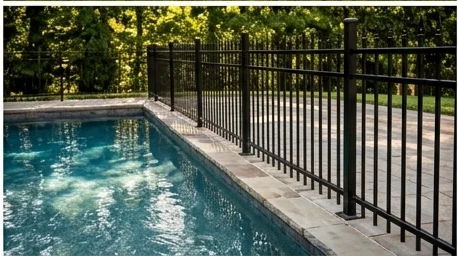
Does a Hot Tub Need a Fence in Jackson and Madison County?
The adopted code treats a hot tub like a swimming pool once the water is deep enough. Here is what that means for your backyard, and the one exception.
Do I need a fence around my hot tub in Jackson or Madison County? Often, yes. The adopted code counts hot tubs and spas as swimming pools when the water is deeper than 24 inches, and an outdoor pool needs a barrier. The exception is a tub with a safety cover that meets ASTM F 1346.
Most pool-fence advice online stops at the pool. Hot tubs get a sentence, if that. Then somebody buys a tub, sets it on a slab by the back door, and finds out at permit time that the building department sees it differently than they did.
This page covers the spa side of it. Our guide to pool fence requirements in Tennessee covers the standard pool rules, and most of those numbers carry over. What changes with a tub is the definition, the exception, and the way a house wall can end up doing part of the work.
One note on where this comes from. The numbers below are taken from two published documents: the Madison County Construction Guide the county adopted in 2025, which reproduces the 2018 International Residential Code pool provisions (Appendix G, section R326), and the City of Jackson Construction Guide, the January 2022 revision, which has its own wording of the pool barrier section. They agree on the big items and differ on a few details. Where they differ, I say so. Codes get amended, so treat this as the starting point and confirm with the building department before you order anything.
Get a free estimate
Call or text Greg at (731) 240-8701, or use the form. Photos of your yard help.
Free on-site estimates in Jackson & West Tennessee.
Why a Hot Tub Counts as a Pool Here
The county's adopted definition of a swimming pool is any structure intended for swimming or recreational bathing that holds water more than 24 inches deep. The definition then says it includes in-ground, above-ground and on-ground pools, hot tubs and spas. That is not a stretch or an inspector's opinion. It is written into the definition. The City of Jackson's barrier section is written for pools and spas in the same way and names hot tubs in its cover exception. It also lets a pool with a powered safety cover skip the barrier sections.
So the first job is a tape measure. If the water in your tub is deeper than 24 inches, you are inside the definition. If a tub is shallower than that, the county definition does not reach it, and I would still call the building department before assuming anything, because the City of Jackson's barrier section does not repeat a depth cutoff in the text I read.
The City of Jackson adds its own sentence on top: "Swimming pool permits are required for all pools over 24 inches deep." The guide does not say in that line whether a hot tub counts, so ask the city whether a deep tub needs a pool permit. The barrier fence has its own fence permit on top of that. More on that below.
The barrier rules are written for residential pools at one- and two-family homes. A house, a duplex, a backyard. This page does not cover commercial or multi-family pools.
Three Backyard Setups, Three Different Answers
Where you land depends on how the tub is set up. Here are the three common cases and what the code says about each.
- A tub with a compliant safety cover. The county text says spas or hot tubs with a safety cover that complies with ASTM F 1346 are exempt from the appendix. The City of Jackson's text is narrower: it exempts a spa or hot tub with a lockable safety cover complying with ASTM F1346. If your cover meets that standard, the barrier requirement does not apply to the tub. The word that matters is "complies." A cover sold only to keep leaves and heat in is not necessarily the same product, so ask for the standard on the label.
- A tub with an ordinary cover, or no cover rating you can prove. No exception. The tub is a pool under the definition, and the yard needs a barrier that meets the dimensions below.
- A tub against the house. A wall of the dwelling is allowed to serve as part of the barrier, but only if it is protected one of three ways. See the house-wall section below.
If you are not sure which case you are in, the cover is the thing to look at first. Find the paperwork or the label, and ask the building department whether that cover satisfies the exception before you decide against a fence. Settle it before you build or skip the fence, not after.
What the Barrier Has to Be
Where a barrier is required, the adopted code is specific. These are the county's numbers for an outdoor tub or pool at a one- or two-family home. The City of Jackson's guide has the same 48-inch height, 4-inch sphere and climbing rules, and it words the bottom gap differently, as covered below:
- The top of the barrier is at least 48 inches above grade, measured on the side facing away from the water.
- The gap between the ground and the bottom of the barrier is no more than 2 inches. The City of Jackson's text allows 2 inches over grass or gravel and 4 inches over a solid surface such as concrete.
- No opening may let a 4-inch sphere pass through.
- The barrier has to be placed so that permanent structures or equipment cannot be used to climb over it.
The City of Jackson's guide goes further on a few points. It asks for the 48-inch height around the whole perimeter and for 3 feet measured out from the barrier, a clear zone of at least 36 inches between the barrier and permanent equipment such as pumps, filters and heaters, and a barrier at least 20 inches back from the water's edge. If you are inside the city, plan to those.
The climbing rule matters more than it looks. A fence can be tall enough and still fail if a deck rail, a stack of pavers, an air conditioner or the tub's own equipment cabinet sits against it and makes a step. When you walk a yard for a pool or spa fence, the climbing path deserves as much attention as the fence height.
The code also limits openings in other kinds of barrier. Where the barrier is built from horizontal and vertical members and the tops of the horizontal members are less than 45 inches apart, the horizontal members go on the pool side and the vertical members may be no more than 1-3/4 inches apart. Where the horizontals are 45 inches or more apart, the verticals may be up to 4 inches apart. For chain link, the county text allows openings up to 2-1/4 inch squares unless the mesh is slatted down to 1-3/4 inch, while the City of Jackson's text caps chain link openings at 1-3/4 inch. Lattice openings are capped at 1-3/4 inch in both. As general practice, owners tend to pick aluminum, ornamental iron, or a solid style, because those are easier to hold to the opening rules from the start.
Gates: Where Most Barriers Fail
A barrier is only as good as its gate, and the code treats the gate as its own list of requirements. A pedestrian gate has to open outward, away from the water. It has to be self-closing and self-latching.
The latch rule is detailed. If the release mechanism sits less than 54 inches above the ground, it has to be on the pool side of the gate, at least 3 inches below the top of the gate, and there can be no opening larger than 1/2 inch within 18 inches of the release. The text does not state the purpose, but the effect is that a small child on the outside cannot easily reach over and open it.
This is also where cheap hardware shows up. A gate that swings fine but does not latch every time on its own is not a self-latching gate. Our gate hardware guide explains which parts do that job and which ones only look like they do.
When the House Wall Is Part of the Barrier
Plenty of tubs sit on a patio right outside a back door, and in that layout a wall of the house is one side of the enclosure. The code allows that, with a catch. In the county's text, the tub needs one of these:
- A powered safety cover that meets ASTM F 1346.
- Listed door alarms (to UL 2017) with a deactivation switch at least 54 inches above the threshold.
- Another means of protection the governing body approves, such as self-closing, self-latching doors, as long as it protects at least as well as the first two.
The City of Jackson's guide lists the same three kinds of protection with its own wording. Its alarm item also covers operable windows with a low sill, and it calls for a safety cover listed and labeled to ASTM F1346 rather than a powered one. Ask the city which option they would accept for your doors.
If you are planning the tub placement before it is delivered, this is worth knowing early. My reading is that putting the tub by the door lets the house wall do part of the work, if the door protection is accepted, and putting it out in the yard means a barrier on every side. Ask the building department which one it would accept for your layout.
Get a free estimate
Call or text Greg at (731) 240-8701, or use the form. Photos of your yard help.
Free on-site estimates in Jackson & West Tennessee.
Permits: The Pool, the Fence, and Your Town
Inside the City of Jackson, three paper trails can apply to one tub. The pool permit applies to pools over 24 inches deep. The barrier fence needs a fence permit, because Jackson requires a permit for every fence, with Planning Department approval. And a powered spa can bring electrical work, which this page does not cover.
The fence permit process, step by step, is in our guide to the Jackson fence permit inspection process. The broader rules, including corner lots and the front-yard vision limit, are in fence permits in Jackson and Madison County.
Outside the city, the county's adopted guide is the one to read. The county's adopted guide is the source of the county numbers above. If you are in Madison County but outside a city, call the county Building Department and ask how they want a spa handled.
Humboldt is the one nearby town I can speak to, and it does not use these numbers. Its municipal code requires an outdoor pool to be fully enclosed by a fence or wall at least 5 feet high, with no opening bigger than 4 inches, and the enclosure needs a permit from the building inspector. Its code applies the enclosure rule to existing pools with at least 18 inches of water, which is shallower than the county threshold. Anybody in Humboldt should work from Humboldt's code, not from this page.
For Medina, Milan, Trenton and the rest, I have not found a pool or spa rule, so I will not repeat one. Medina, for one, adopts its zoning by reference and keeps it at the city recorder's office. Call city hall and ask what they require around a hot tub.
Which Fence Works Around a Tub
Material choice follows the rules above. The barrier has to be 48 inches or taller, keep the bottom gap small, and have no gap a 4-inch sphere can pass. Several styles do that without much trouble.
- Ornamental aluminum. As general practice, it is a common choice for pool barriers because picket spacing is easy to hold to the opening rules and it shows the tub without hiding it. See pool fencing for the details.
- Solid privacy fence. A privacy fence with no gaps can meet the opening rule easily. It also gives the tub the privacy most people want in the first place. Check the gate, the bottom gap, and the climbing path. Our privacy fencing page covers the styles.
- Chain link. It can qualify if it meets the mesh limits above, which in practice means slats. Check which office's limit applies to you.
If you already have a privacy fence, whether it can serve as the barrier depends on its height, the gate and the bottom gap. It is a reasonable question for the estimate, and a measuring tape settles most of it.
Questions to Ask the Building Department
Some things I cannot answer from the adopted text, and nobody should answer them from a forum post. Here is what to ask, and who to ask it of:
- Does my specific cover satisfy the ASTM F 1346 exception, including the lockable requirement in the city's text, and what paperwork do you want to see?
- Do you treat a portable or inflatable tub with a locking cover the same way as a built-in spa? The code text does not settle that, and I have not found an inspector's published position.
- Will you accept my house wall, with door alarms, as one side of the barrier?
- Does the barrier fence need its own permit, and can both permits be filed together?
The answers to the first two are the ones worth getting in writing. If you are inside Jackson, that is the city's building and planning staff. If you are in the county, it is the county Building Department. In any other town, start with city hall.
Common Questions About Hot Tub Fences
Is a hot tub considered a swimming pool in Tennessee?
+Under the code Jackson and Madison County enforce, yes, when the water is more than 24 inches deep. The adopted definition names hot tubs and spas along with in-ground, above-ground and on-ground pools.
Does a hot tub cover replace the fence?
+Only a safety cover that complies with ASTM F 1346 qualifies for the exemption, and the City of Jackson's text says the cover must be lockable. Ask the building department to confirm that your cover meets the standard before you skip the barrier.
How tall does a hot tub barrier have to be?
+At least 48 inches above grade on the side facing away from the tub, with no opening a 4-inch sphere can pass, in both the county's text and the City of Jackson's guide. The bottom gap is no more than 2 inches in the county's text; the city allows 2 inches over grass or gravel and 4 over a solid surface. Humboldt is different: its code calls for a fence or wall at least 5 feet high.
Can the back of my house serve as one side of the enclosure?
+Yes, in the county's text, if the doors opening onto the tub area are protected by a powered safety cover, listed door alarms with a deactivation switch at least 54 inches above the threshold, or another approved method. The City of Jackson's guide lists similar options. The fence covers the other sides.
Do I need a permit for a hot tub fence in Jackson?
+Yes for the fence, because Jackson requires a permit for every fence. Jackson also requires pool permits for pools over 24 inches deep. The city's guide does not say in that line whether a tub counts, so call and ask how they want a spa filed.
Where This Leaves You
Measure the water depth. Find out whether your cover truly meets the standard. Look at the back door, because that one wall can change the whole layout. If a barrier is needed, build it to the 48-inch and 4-inch numbers, keep the bottom gap tight, and give it a gate that closes and latches on its own.
If you are planning a tub and a fence together, the easiest time to sort this out is before the tub is delivered. Call or text and give us the address and the tub's footprint. We will talk through the layout and the fence installation around it. The alarm that Tennessee separately requires on new pools is a different rule from the barrier, and our guide to the pool alarm law and the fence lays out the difference.
Get a free estimate
Call or text Greg at (731) 240-8701, or use the form. Photos of your yard help.
Free on-site estimates in Jackson & West Tennessee.
More plain-English answers on cost, permits, materials, and repairs are in all of our fence guides.